

Signs of mold under hardwood floors showed up in my fourth apartment three months after I moved in, and I did not recognize any of them until my mom came to visit and could not stop coughing. The first sign was a smell that arrived every afternoon around four o'clock and was gone by morning. The second sign was a place in the living room floor that felt slightly spongy when I walked across it in socks, the way a bathtub feels when the caulk at the edge has gone soft. The third sign was a small line of dark spots along the baseboard behind the couch that I had been wiping clean with a wet rag once a month because I assumed it was dust. None of those signs on their own would have made me pick up the phone. All three of them together, on the same week my mom's asthma flared up, are what made me call the landlord, and what eventually made the building send an inspector with a moisture meter. The kitchen sink had a hairline leak at the P-trap that had been dripping onto the subfloor for about five months before I signed the lease—so by the time I noticed the signs, it had been leaking for about eight months. The leak had not pooled anywhere I could see. The leak had been feeding a colony of mold that was growing under my living room hardwood floor, exactly under the place I sat every evening to read. The signs of mold under hardwood floors were not the things I expected. They were the things I had been explaining away for weeks.
I had been a renter for nine years before that fourth apartment. I had lived in two apartments with wall-to-wall carpet, two with hardwood, and one with laminate. I had cleaned mold off a bathroom ceiling once and a kitchen faucet twice. I knew that mold was bad and that bleach killed it. I did not know that mold under a hardwood floor could grow for eight months without ever showing on the surface of the boards. I did not know that the smell I had been writing off as a sweet cleaning product was the smell of actively growing mold, and I did not know that the spongy spot in the floor was a place where the subfloor underneath had begun to soften from sustained moisture. The inspector who came to my apartment was a woman named Carla who had worked for the building's environmental consultant for nineteen years, and she told me three things that I now consider the foundation of what I know about mold under hardwood floors. The first is that mold almost never starts on top of the wood. The second is that the smell is usually the first sign and it usually shows up before any visible spot. The third is that the renter who catches it in the first three weeks is the renter who keeps the deposit.

My Astoria Apartment Smelled Sweet for 4 Weeks Before I Reacted
The Astoria one-bedroom was the fourth apartment I had rented on my own and the second with what the listing agent called "exposed character hardwood throughout." The listing photo showed the floors golden and shiny. The listing did not mention that the kitchen sink had a hairline leak at the P-trap that had been dripping onto the subfloor for the better part of a year before I signed the lease. I did not see the leak during the walkthrough because the cabinet under the sink was full of cleaning supplies that the previous tenant had left behind. The leak dripped about a cup of water a week onto the plywood subfloor under the kitchen, and the moisture wicked east about six feet across the subfloor before it reached the threshold where the hardwood began in the living room.
The first sign I noticed was the smell. It started in the third week of October, three months after I moved in, and it showed up only in the late afternoon. The smell was not the musty basement smell I had been trained to associate with mold. The smell was sweeter than that, almost like a cheap fabric softener, with something underneath that reminded me of the smell inside a closed-up car that has been sitting in the sun. I told myself the smell was the new couch cushions off-gassing. I told myself the smell was the radiator turning on for the first time that fall. I told myself the smell was my neighbor's cooking. I told myself every explanation except the right one for four weeks.
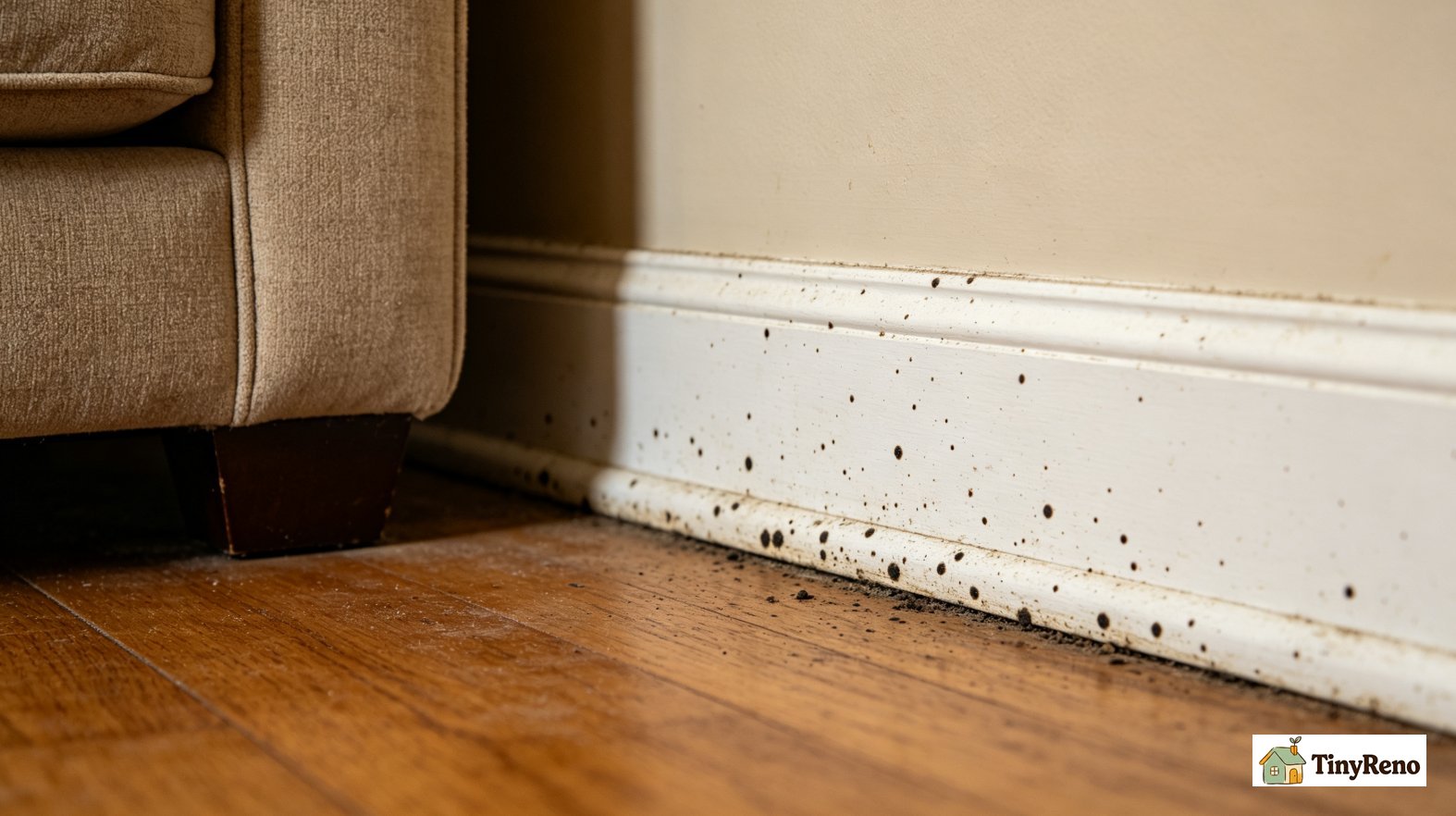
The second sign was the floor itself. In early November, I started noticing that one spot in the living room, about three feet in from the kitchen threshold and right where my reading chair sat, felt slightly soft underfoot. The softness was not a creak. The softness was the way a sponge feels when you press on it from above, the boards giving maybe a sixteenth of an inch before they came back. I told myself it was a loose board. I told myself the building had settled. I told myself every explanation except the right one for another two weeks. The third sign was the baseboard. Behind the couch, where the wall met the floor, there was a line of dark gray dots about the size of pencil lead that I had been wiping with a damp rag once a month because I assumed it was dust. The dots came back every time. The dots spread by about half an inch over those six weeks. I did not connect any of the three signs to each other until the fourth sign showed up: my mom.
I Called the Landlord the Night My Mom Couldn't Stop Coughing
My mom came to visit for a long weekend in mid-November. She has had asthma since she was eleven, and the asthma has been controlled for the last twenty years on a daily inhaler and an emergency inhaler she keeps in her purse. By the second night of her visit, she had used the emergency inhaler three times and had not slept more than ninety minutes straight. She told me at breakfast on Sunday that she did not think she could stay another night. She said the apartment smelled funny and that her chest felt tight the way it used to feel when she was a kid and her dad smoked in the house.
I called 311 that morning from the kitchen and opened a complaint with the New York City Department of Health about a possible mold condition in the apartment. The 311 operator took my address, my landlord's name, and a short description of what I had observed. She gave me a complaint number. Then I sat down at my computer and wrote the landlord an email. The email was six sentences. It described the smell, the spongy floor, the dark spots on the baseboard, my mom's asthma attack, and the 311 complaint number. The email asked for a professional mold and moisture inspection within seven days. I sent the email at 9:14 in the morning. The landlord replied at 11:42 the same morning, less than three hours later. He said he would send the building's environmental consultant on Wednesday.
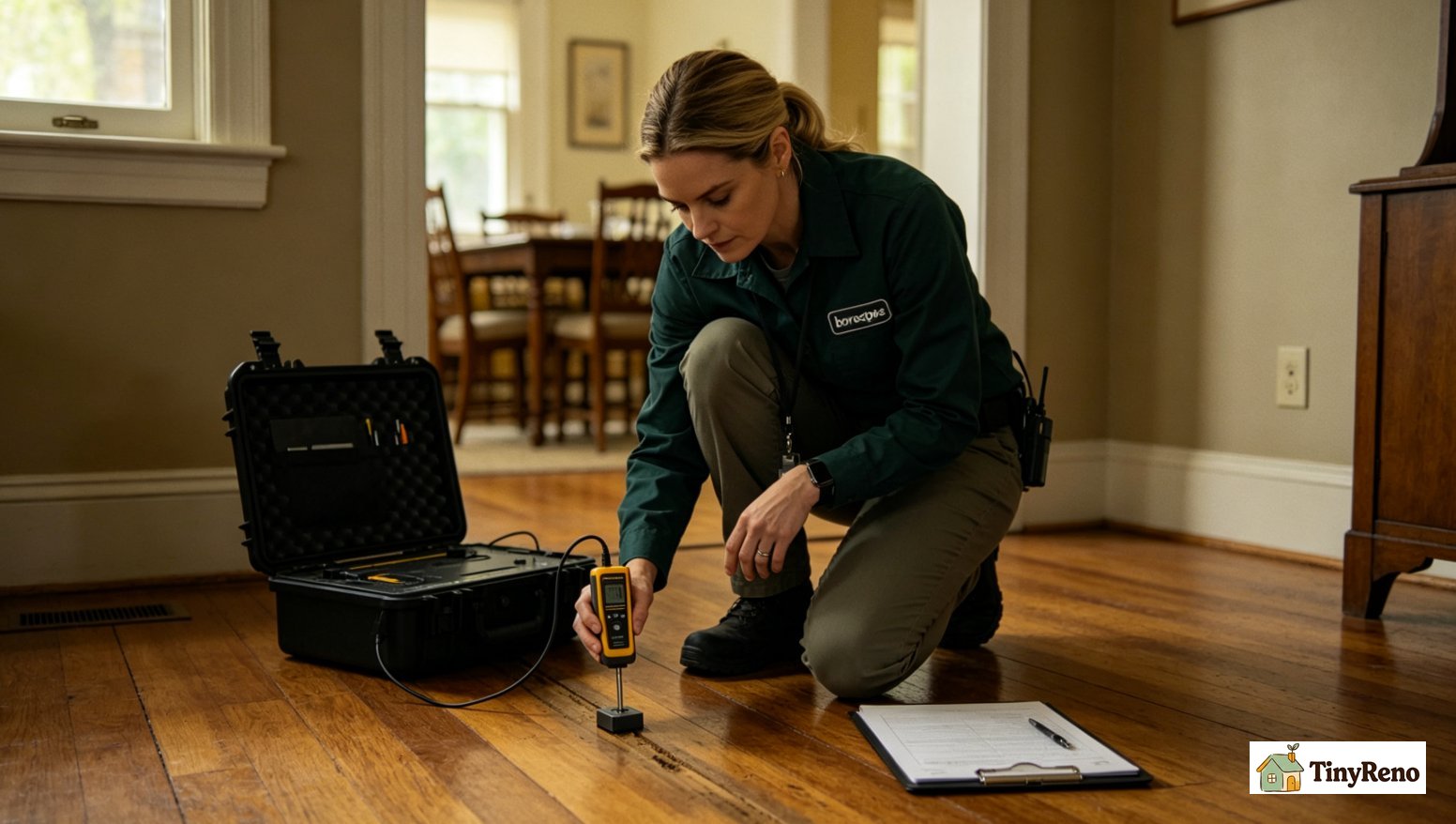
Carla, the inspector, arrived at 9:30 on Wednesday morning with a metal case that held a moisture meter, a borescope, three sample bottles, and a clipboard with a checklist. She spent three hours in the apartment. She tested eleven different points on the floor with the moisture meter. She drilled two pinholes in the living room floor near the spongy spot and fed the borescope through to look at the subfloor. She took two air samples and one surface sample from the baseboard. By noon, she had three findings. The first finding was that the moisture meter read 28 percent in the kitchen subfloor and 19 percent in the living room subfloor, both well above the safe range of under 12 percent for plywood subfloor under hardwood. The second finding was that the borescope showed visible white and gray growth on the underside of the subfloor and the back of the hardwood boards across about a twelve square foot area under the living room. The third finding was that the air sample showed elevated spore counts for aspergillus and penicillium, the two molds that grow most often under slow leaks in residential buildings.
The landlord sent a remediation crew the following Monday. The crew pulled up about 80 square feet of hardwood from the living room and kitchen threshold, cut out and replaced a six square foot section of subfloor, ran three industrial dehumidifiers for five days, and then reinstalled new hardwood in the patched area. The total cost of the work, according to the invoice the landlord emailed me, was $11,400. The landlord paid the entire invoice. The landlord did not deduct a dollar from my deposit. The reason the landlord did not deduct a dollar from my deposit was that the email I had sent him on Sunday morning, with the 311 complaint number, was the document that proved I had reported the problem the moment I had a reason to connect the three signs to each other. That email, plus the photos I had taken of the baseboard dots and the meter readings Carla had given me, was the evidence chain that protected $4,200 of my deposit that would otherwise have been negotiable.
The 5 Early Clues of Mold Under Hardwood Floors (Not Just the Smell)
The five early clues of mold under hardwood floors are the things Carla taught me during the three hours she spent in the apartment, plus the three things I have since noticed in the two hardwood apartments I have rented after the Astoria one. None of these clues on their own proves that there is mold under the floor. All five of them appearing in the same apartment in the same season is the pattern that should send a renter to the phone. The first clue is the smell, and the smell is not the musty basement smell most people associate with mold. The smell of actively growing mold under a subfloor is sweet and slightly damp, the smell of a wet towel that has been left in a closed bathroom for two days. The smell usually shows up in the late afternoon when the apartment warms up and the air handler kicks on, and it usually goes away by morning when the temperature drops.
The second clue is a soft or spongy spot in the floor. The spot is usually localized, often within six to ten feet of a water source like a kitchen sink, a dishwasher, a refrigerator ice maker, a bathroom toilet, or a washing machine. The spot feels different from a loose board. A loose board gives a creak. A soft spot gives under your weight the way a sponge does, and you can sometimes see the boards dip a sixteenth of an inch when you step on them while looking at them from the side. If the spot is over a plywood subfloor and the plywood has been wet for more than a month, the plywood will have begun to soften. Carla told me that she has measured floors that gave a quarter inch under a 180 pound person, and that the subfloor under those floors had lost about half of its structural strength.
The third clue is a line of dark spots along the baseboard. The spots are usually black, dark green, or very dark gray. They cluster in places where the wall meets the floor and where the air cannot move, which is why they tend to show up behind furniture first. The spots do not wipe off with a damp rag the way dust does, because the dark color is not on the surface. The dark color is on the inside of the baseboard, which is where the mold has colonized the MDF or the pressboard. Wiping the surface does not kill the colony. Wiping the surface actually feeds the colony by adding moisture. The fourth clue is a floor gap that is wider than the seasonal gaps in the rest of the apartment. Carla measured every gap in my living room floor on the day of the inspection. The seasonal gaps ran about an eighth of an inch. The gap near the spongy spot ran a full quarter inch, almost double. The wider gap was a sign that the boards near the moisture source had swollen from absorbing water and then shrunk unevenly as they dried, leaving wider gaps than the rest of the floor.
The fifth clue is a humidity gradient between rooms. A normal apartment has humidity readings that vary by maybe three or four percent from room to room. An apartment with a hidden moisture problem has humidity readings that vary by ten percent or more, with the room closest to the moisture source reading higher than the rest of the apartment. The test is simple. Buy a $14 digital humidity gauge. Put it in the living room for 24 hours. Move it to the bedroom for 24 hours. Move it to the kitchen for 24 hours. If the kitchen reads more than ten percent higher than the bedroom, there is moisture coming from somewhere in or under the kitchen. The moisture might be a slow leak, a missing tile of subfloor ventilation, or a faulty dishwasher drain. The moisture is also probably feeding mold.
The 3 Mistakes That Almost Cost Me $4,200 (and the 1 Move That Saved It)
The three mistakes I made during the four weeks I was smelling the sweet smell in the Astoria apartment are the three mistakes Carla told me she sees in almost every mold case she inspects, and they are the three mistakes that almost cost me my deposit. The first mistake was spraying bleach on the baseboard dots. I bought a spray bottle of bleach at the bodega, sprayed the dark spots behind the couch, wiped them with a paper towel, and repeated the spray every few days when the spots came back. Bleach kills mold on hard non-porous surfaces like tile and glass. Bleach does not kill mold growing inside the MDF baseboard. Bleach also adds moisture to the area, which feeds the colony underneath. Carla told me that every renter she has worked with has sprayed bleach on visible mold at least once before calling her, and that the bleach almost always makes the problem worse. The right move on visible baseboard spots is to photograph them and leave them alone until a professional can sample them.
The second mistake was using a wet mop on the floor near the spongy spot. The building's cleaning crew had come twice during my first three months in the apartment, and both times they had run a wet mop across the entire living room floor because the hardwood looked dull. The wet mop added about a cup of water to the floor each time, and the water wicked into the gaps between the boards and down into the subfloor. The subfloor did not need more water. The subfloor needed the leak under the kitchen to be fixed. The right move on hardwood floors is to use a barely damp microfiber mop, not a wet mop, and never to let any water pool on the surface for more than thirty seconds.
the short window between noticing a problem and reporting a problem is the window most lease agreements use The reason I waited was that I did not want to be the tenant who calls about a smell. The reason I waited was that I was afraid of being told the smell was normal. The reason I waited was that I did not know that the three-week window between noticing a problem and reporting a problem is the window most lease agreements use to decide whether a problem is something the renter knew about and failed to report. Carla's advice to every renter she meets is the same: report the day you notice, not the day you understand. The email I finally sent on the Sunday morning my mom could not stop coughing was the move that saved my $4,200 deposit, because the timestamp on that email proved I had reported the problem within hours of having a legitimate reason to connect the three signs to each other.
The single move that saved me was the email plus the 311 complaint on the same day. The email to the landlord started the private repair conversation. The 311 complaint created a public record that the city health department was aware of the problem. The combination of those two documents, sent within four hours of each other on the same Sunday, is what made the landlord take the problem seriously enough to bring in Carla on Wednesday and to send the remediation crew the following Monday. Either one of the documents alone would have been weaker. The email alone would have been deniable. The 311 complaint alone would have been adversarial. The email plus the 311 complaint was the renter's version of a belt and suspenders, and it is the move I now make every time I see the second sign of any problem in a rental.
The 5 Steps Renters Can Run Before Calling a Contractor
The five steps a renter can run in their own apartment before calling a contractor or even the landlord are the steps that will tell you whether the three signs you are seeing are worth a 311 complaint or just a Saturday cleaning. None of these steps cost more than twenty dollars, none of them take more than thirty minutes per step, and none of them require the landlord's permission. The first step is to buy a moisture meter. A pin-style moisture meter for wood costs between twelve and twenty dollars at any hardware store. Press the pins into the surface of the hardwood near the soft spot and at three other points in the apartment. A reading above 14 percent on a pin meter is a sign of abnormal moisture. A reading above 20 percent is a sign of an active moisture problem that needs professional attention.
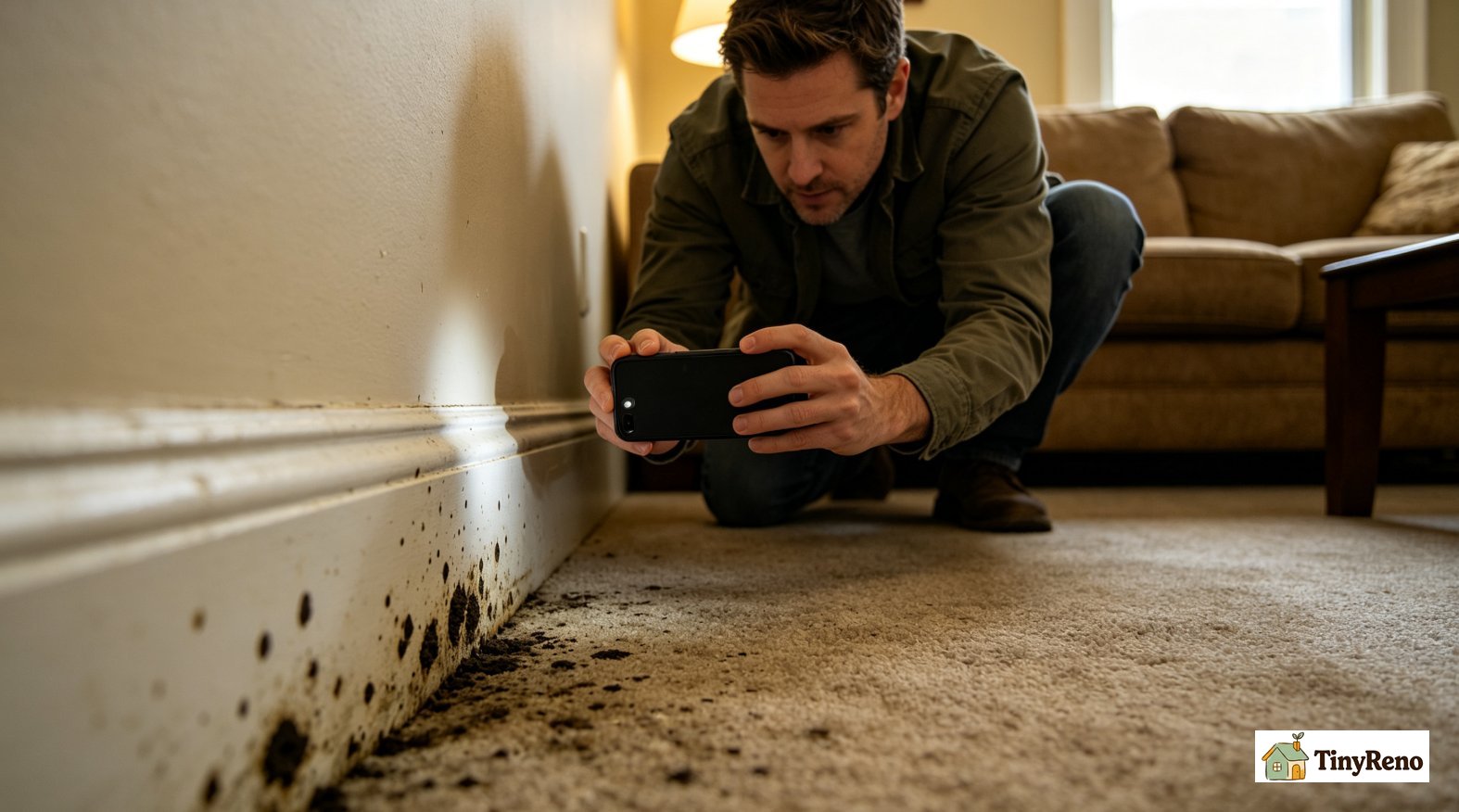
The second step is to photograph the baseboard spots with your phone camera. Use the macro lens if your phone has one. Take the photo with the flash off and with the phone about six inches from the spot. The photo should be sharp enough that you can see the texture of the baseboard material. Save the photo with the date in the filename. The photo is evidence for the email you will send to the landlord, and the photo will also let you compare week to week whether the spots are spreading. The third step is to run the humidity gradient test. Buy a digital humidity gauge for between ten and fifteen dollars. Put it in the living room for 24 hours and write down the highest reading. Move it to the bedroom for 24 hours. Move it to the kitchen for 24 hours. If the kitchen reading is more than ten percent higher than the bedroom reading, you have a moisture source in or under the kitchen.
The fourth step is the afternoon smell test. Walk into the apartment at four in the afternoon for three days in a row, close the front door, and stand still for sixty seconds. Note whether you smell anything sweet, musty, or chemical. Note whether the smell is stronger in the living room than in the bedroom. The smell test is not as objective as a moisture meter reading, but it is the test Carla said her clients use most often to decide whether to call her. The fifth step is to write a single email to the landlord that documents everything you have observed. The email should include the date, the three signs, the moisture meter readings if you have them, the humidity gradient numbers if you have them, and one explicit ask: a professional mold and moisture inspection within seven days.
The total cost of the five steps is between thirty-five and fifty dollars. The total time is about three hours spread over a week. The total value of the five steps is that they give a renter the evidence chain needed to make a 311 complaint credible, to make a landlord email actionable, and to make a remediation case defensible if the landlord ever tries to blame the renter for the moisture problem. I have run the five steps in three apartments since the Astoria one. In two of those three apartments, the steps found nothing and I moved on with my Saturday. In the third apartment, the steps found a slow leak under the laundry room that the landlord had missed for two tenants before me. The leak was fixed within ten days. The deposit came back in full. The five steps are now the first thing I do in any new rental that has a smell I cannot name.


Discussion (0)
Sign in to join the discussion