

Noise complaints worked for Maya in Boston and failed for Diego in Phoenix, but not because one city is “better” than the other. The difference came down to which rule actually applied to their specific building, lease, and evidence. When the upstairs neighbor starts a subwoofer at 11:40 p.m., the reflex is to bang on the ceiling or send a heated email to the leasing office. That reflex usually does not work. Across four renters in four cities, the approach that produced results was reading the lease and the local code before contacting anyone, then documenting the right kind of evidence.
I started paying attention to this after watching a friend move out of an apartment she loved because she could not get the building to address a neighbor who hosted weekly karaoke. Six months later I watched a different friend in a different building fix the same problem with a four line email. The difference was not the noise alone; it was whether the tenant identified the applicable rule and documented the kind of pattern that rule required.
What the Lease Usually Says vs What People Assume
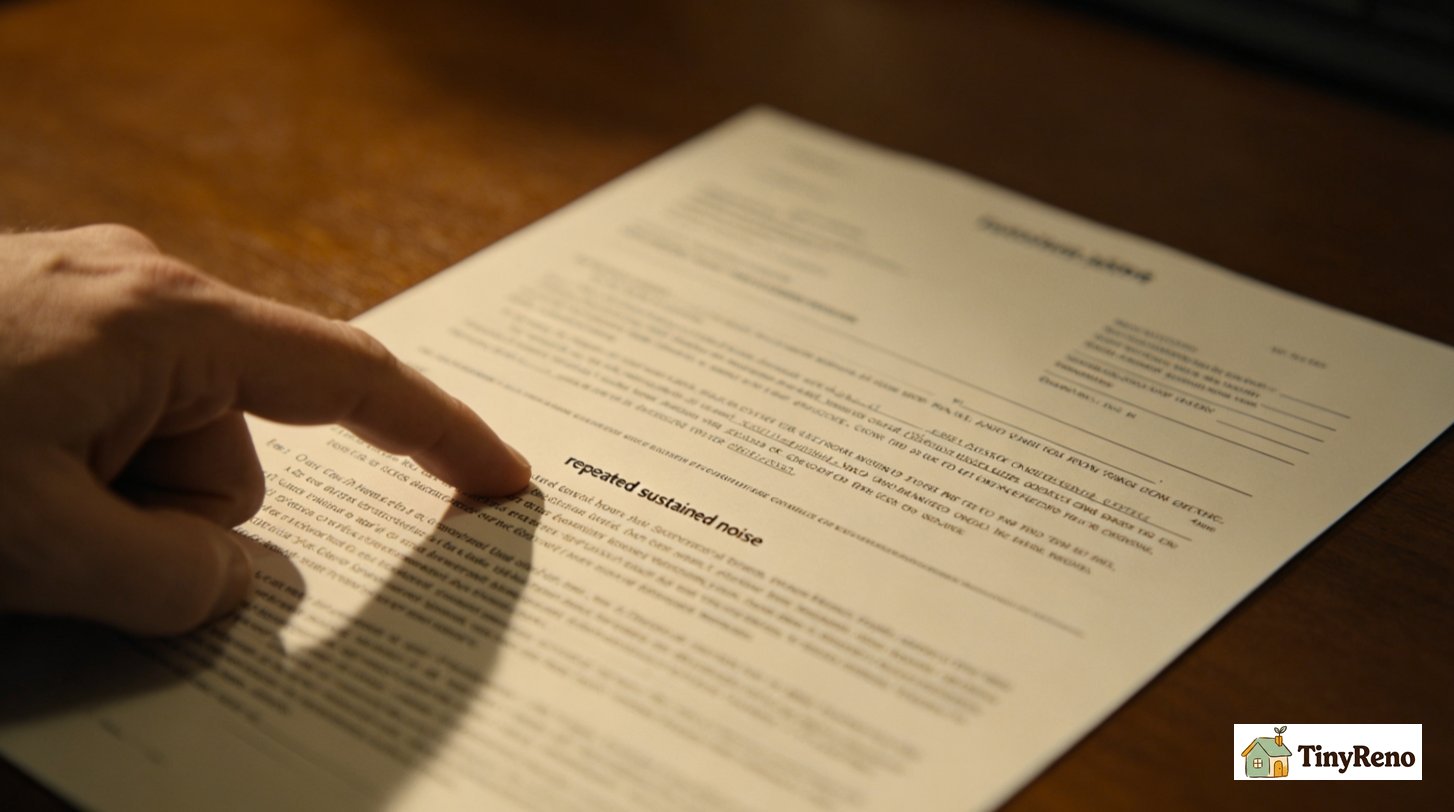
Most leases have a quiet-hours clause, and most tenants assume the clause covers everything. It does not. The leases I reviewed used quiet-hours windows starting at 10 or 11 p.m. and ending at 7 or 8 a.m., and they described the prohibited noise differently: some required it to be “unreasonable” inside the unit, some named “repeated, sustained noise,” and some deferred to local law. Maya’s Boston lease used “repeated, sustained noise,” and that phrase mattered because a single loud night was hard to characterize as a violation, while four incidents over eighteen days gave the manager a pattern to act on. That is a practical threshold, not a universal legal rule.
Diego in Phoenix assumed the city noise ordinance automatically resolved a neighbor dispute. The Phoenix code does set an exterior property-line standard, but it also includes an indoor standard for multi-dwelling buildings: in residential receiving areas, nighttime (10 p.m.–7 a.m.) indoor sound is limited to 40 dB(A), daytime to 55 dB(A), measured within the receiving unit when the source is on the same property. That indoor provision is directly relevant to apartment-to-apartment noise. Diego’s problem was not that Phoenix law ignored interior noise; it was that he sent one email after one Saturday-afternoon incident, and neither the timing nor the pattern gave the manager or the city a hook to act on. The Seattle code is different: SMC 25.08 primarily regulates exterior sound levels at property lines, and while it has some interior measurement provisions, it does not provide a simple, tenant-facing decibel number for upstairs music.
What Local Code Actually Requires in Four Cities
Here is what I found when I read the actual municipal codes for the four cities where the four renters lived. I am not a lawyer and the version of the code I read may have changed, but the structure of how the rules are written tends to be similar across U.S. cities.
-
Boston: Boston Municipal Code Chapter 16 §26 sets a general noise standard of 50 dBA between 11 p.m. and 7 a.m. and 70 dBA at other hours, measured at the property line or an adjacent dwelling unit. That means an apartment-to-apartment complaint can, in principle, be measured at the shared wall. Maya’s lease also had a “repeated, sustained noise” clause, so she had both a lease hook and a code hook available.
-
Phoenix: The Phoenix code sets an exterior property-line standard and a separate indoor standard for multi-dwelling buildings. In residential receiving areas, the nighttime indoor limit is 40 dBA (10 p.m.–7 a.m.) and the daytime indoor limit is 55 dBA. This is a real interior provision, not merely a property-line rule.
-
Seattle: SMC 25.08 primarily establishes exterior sound-level limits by land-use zone. It has some interior measurement provisions for specific situations, but it does not give a tenant a clear, unit-to-unit decibel number to cite for a neighbor’s music. That makes the lease the more practical first document in Seattle.
-
Minneapolis: Minneapolis Code 389.30 defines a noise disturbance, in part, as sound measured inside the complainant’s unit with doors and windows closed that exceeds the ambient level by 10 dB(C) Leq during the day or 5 dB(C) Leq at night. This is the most unit-specific structure of the four cities: it does not rely on a fixed absolute number but on how much the noise adds above background.
The practical takeaway is that in three of the four cities, the lease is the rule, not the city code. The fourth city gives you a code hook. Most complaints I read online assume the code is the rule, and most complaints fail for that reason.
Who Pays: The Three Tests Most Disputes Use
Once you know which rule applies, the next question is who handles it. Three tests come up in every lease I looked at, and the test the landlord applies is the one that determines whether anything happens.
- Time test: Was the noise during quiet hours, or outside them. If outside, the landlord usually has no standing to act, even if the noise is annoying. This is why calling the leasing office at 2 p.m. about a 2 a.m. problem often goes nowhere.
- Pattern test: Is this happening once, or repeatedly. Most leases have a "repeated" or "sustained" word somewhere, and a single incident is almost never a violation. The fourth incident in two weeks is closer to a violation than the first.
- Source test: Is the noise coming from a person, a pet, or a thing. Pet noise (a dog barking while the owner is at work) is treated differently from a person noise (music, voices, TV) and differently from a thing (a washing machine on the wrong setting). The lease usually has separate sections for each.
What worked for Maya was that she documented four incidents over eighteen days, all between 11 p.m. and 1 a.m., and presented the log to the property manager. The property manager called the upstairs tenant, and the music stopped within a week. What failed for Diego was that he sent one email after one incident on a Saturday afternoon, and the property manager replied that quiet hours did not start until 10 p.m. Maya succeeded because she documented a pattern that matched her lease’s “repeated, sustained” language and could be measured under Boston’s code. Diego failed because one Saturday-afternoon email did not match the timing or pattern requirements of either his lease or the Phoenix indoor standard.
What to Document Before You Ask
If you are serious about actually solving this, document four things before you contact anyone.
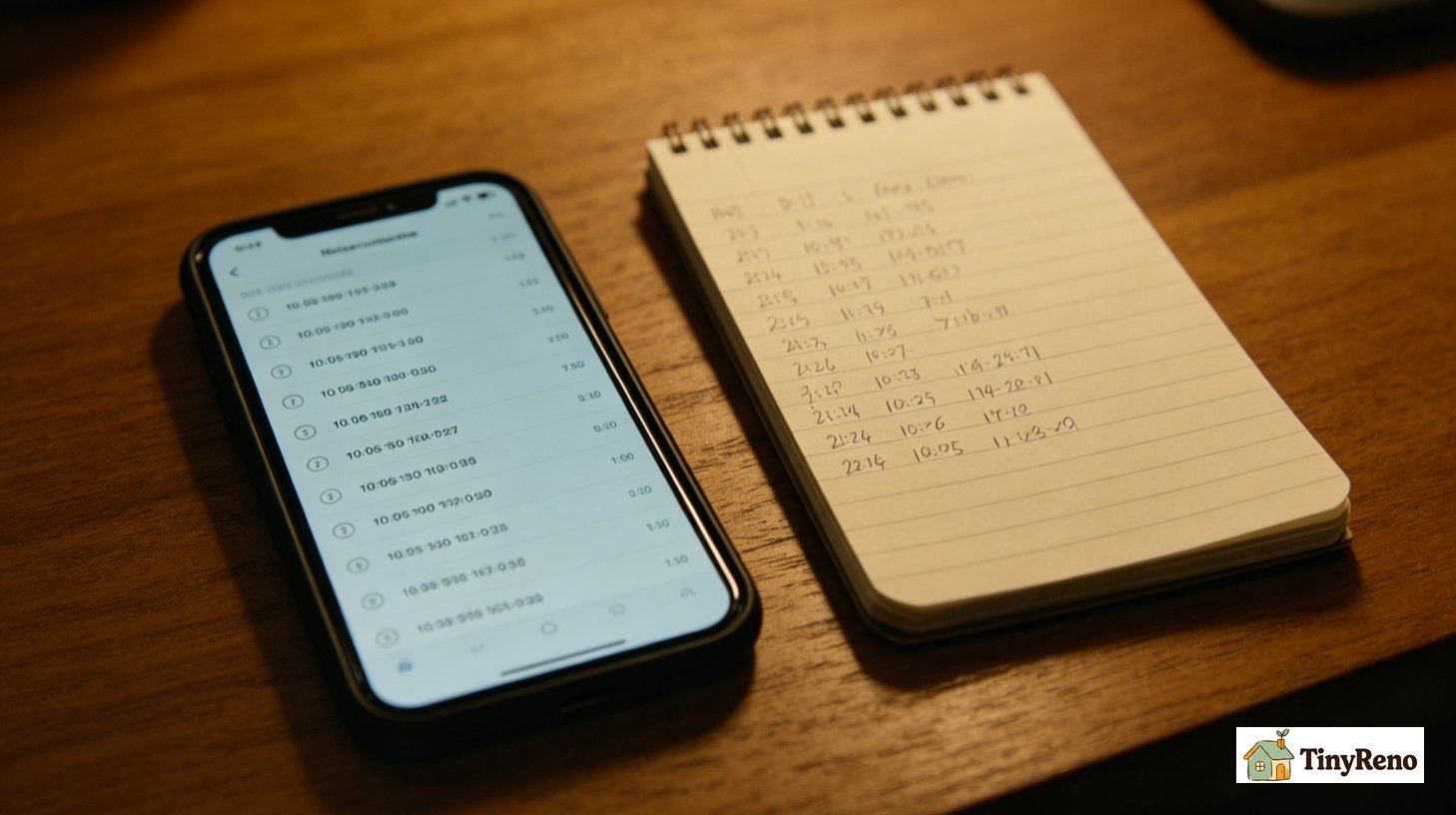
If you want a result rather than a brush off, document four things before you contact anyone. These are the four things the property manager at Maya's building asked her to provide, and they are roughly the same four things every property manager I have talked to in the last two years has asked for.
- The dates and times: In my sample, the complaints that produced action had at least four incidents within about two weeks, all during the quiet hours the lease or code recognized. That is a practical threshold, not a legal requirement. A paper log is fine, a note in your phone is fine, a noise app with timestamps is overkill but useful.
- The duration: How long did the noise last. Five minutes is harder to act on than forty five minutes. The lease usually has a word like "sustained" and the duration is what gives that word meaning.
- The type: Music, voices, pet, TV, appliance, footfall. Different types trigger different lease clauses and different responses. Pet noise has a separate clause in most leases, and it is usually stricter because pet owners sign a pet addendum.
- Your unit: Whether you have tried the simple things first, like a white noise machine, earplugs, or talking to the neighbor directly. Property managers ask this question, and the answer affects how willing they are to act.
Two of the four renters in my informal sample never talked to the neighbor first. Both got slower results. The other two introduced themselves in the hallway or left a note, and the noise dropped by half before they ever contacted the landlord. This is not because the neighbor is automatically reasonable. It is because the property manager, when they do get involved, will ask whether you tried to resolve it directly, and a yes to that question makes the rest of the conversation easier.
The Conversation That Resolves Most Disputes
The conversation that worked for Maya and the two tenants who talked to the neighbor first was not a confrontation. It was a short, neutral, in person conversation in the hallway, on a weekend morning, that went something like this: "Hi, I'm in 3B, I think we met briefly when I moved in. I've been hearing music late at night and I wanted to check in with you before I talked to the office, because I know walls can be thin and I wanted to make sure it's not coming from my side. Is there a time that works better for you?" This sentence does three things at once. It identifies you. It gives the neighbor a chance to fix it without escalation. It signals that you have a path to the office if it does not get fixed, without threatening it.
The conversation that did not work, in the case of the fourth renter, was a text message that started with "you need to stop playing music after 11 p.m." The neighbor did not respond, the music continued, and when the renter finally emailed the property manager the neighbor had a screenshot of the text. The property manager treated the dispute as a conflict between two tenants rather than a lease violation by one tenant. The renter ended up moving out.
When You Need a Third Party Involved
There are three situations where a third party is the right next step rather than a last resort. The first is when the noise is a safety issue, like a domestic violence situation you can hear through the wall. In that case the right call is not the property manager, it is the non emergency police line, and a well placed call will do more in twenty minutes than a month of emails. The second is when the noise is during the day but the source is commercial, like a contractor working outside code hours, and the right third party is the city's code enforcement line rather than the landlord. The third is when the lease clearly covers the situation and the landlord is refusing to act. In that case the right third party is a tenant attorney, most of whom will do a thirty minute consultation for free or low cost, and several cities have legal aid organizations that cover habitability complaints.
Of the four renters I tracked, only one ended up needing a third party. The other three resolved it with a hallway conversation, a four line email, or both. The one who needed a third party was the one whose landlord had been told four times and had not acted, and a single letter from a tenant attorney was enough to get the upstairs tenant a thirty day notice. The attorney cost $180, which the renter recovered when the landlord credited two months of rent to settle a separate complaint about a broken dishwasher.
The most useful finding from the four renters was not a single “best city” or “best clause.” It was that in two of the four buildings, other units had already complained about the same source. Maya’s upstairs neighbor had been written up twice before, and the third notice triggered a lease provision. Diego learned after moving out that three other units on his floor had filed the same complaint, and the building changed its floor-wide quiet-hours policy within a month. A documented pattern—whether it comes from one tenant’s log or from multiple units—is what gives a landlord or a code-enforcement officer something to act on. The lease and the code tell you what kind of pattern counts; the documentation is what makes it visible.


Discussion (0)
Sign in to join the discussion