

My wife asked me how to decorate our small living room on a budget without it looking like a dorm on a Thursday in March. We were standing in the middle of a 380-square-foot one-bedroom in Tremont, Cleveland, with a tape measure in one hand and a half-eaten bag of pretzels in the other. The living room was eleven by fourteen feet, with a west-facing window, a beige wall my landlord had painted in 2019, a cord-brown couch my in-laws gave us when we married, and a coffee table I carried up three flights of stairs in 2021. The budget was $380, which was what remained in our joint checking after first month and security on the new place. We had one weekend. By Sunday night the room no longer felt like a dorm, and it did not feel like we had spent nothing. Six swaps did it; the order mattered, and the floor lamp did the most to change the room.
We moved into the Tremont apartment in February, and for the first six weeks we left the living room empty except for the inherited couch and a folding card table my wife used as a desk. The room looked like a place we were storing furniture, not a place we lived. My wife grew up in a house in Lakewood where her mother redecorated the living room every two years, and the contrast was starting to bother her in a way I could measure in sighs. She did not want to spend money we did not have, but she also did not want to live in a beige box for a year. The search for how to decorate a small living room on a budget without it looking like a dorm is what brought us to the six swaps below.
The Six Swaps, In The Order We Did Them
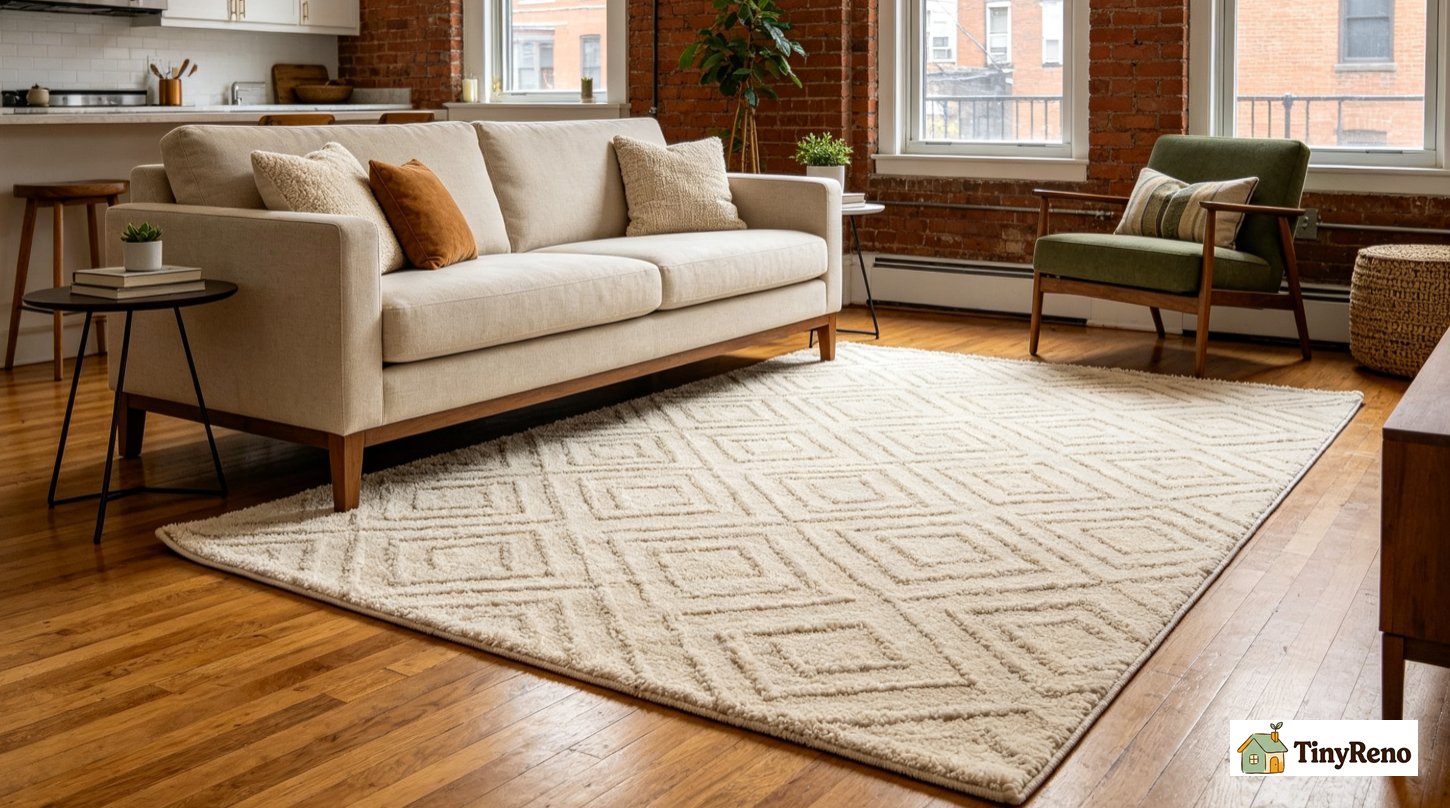
Swap one was the rug. We measured the room with the tape measure, and the answer came back as eleven by fourteen, which is a weird rug size that no one makes. The convention is to leave six to twelve inches of floor visible on every side, which would mean a nine by twelve. The nine by twelve rug at Target was sixty-nine dollars on sale, which was the cheapest we could find without going to a discount store. We ordered it Friday night. It arrived Saturday morning. We unrolled it in the middle of the room and the room changed the moment the rug touched the floor. The beige wall was still there, the cord-brown couch was still there, but the rug gave the room an anchor and a center. This is the swap that does the most visual work for the least money. A rug does not have to be expensive to anchor a room. It has to be the right size and the right tone. We went with a low-pile cream rug with a subtle geometric pattern that disappeared at a distance and added texture up close.
Swap two was the floor lamp. This is the one that changed the room. The room had overhead lights but the overhead lights were a single sixty-watt bulb in a flush mount that threw a flat, even, and unflattering light across the entire room. A single overhead light is the single biggest reason a small living room feels like a dorm. The fix is a second light source, and the cheapest second light source is a tall floor lamp in a corner. We bought a seventy-nine-dollar IKEA floor lamp with a paper shade, the kind that diffuses light through the shade rather than throwing it across the room. We put it in the back-left corner of the room, behind the couch, and the moment we turned it on, the back of the room became visible and the front of the room felt deeper. The flat overhead light was still there, but it was no longer the only light, and the room no longer felt like a dorm. This swap alone was worth more than the rug.
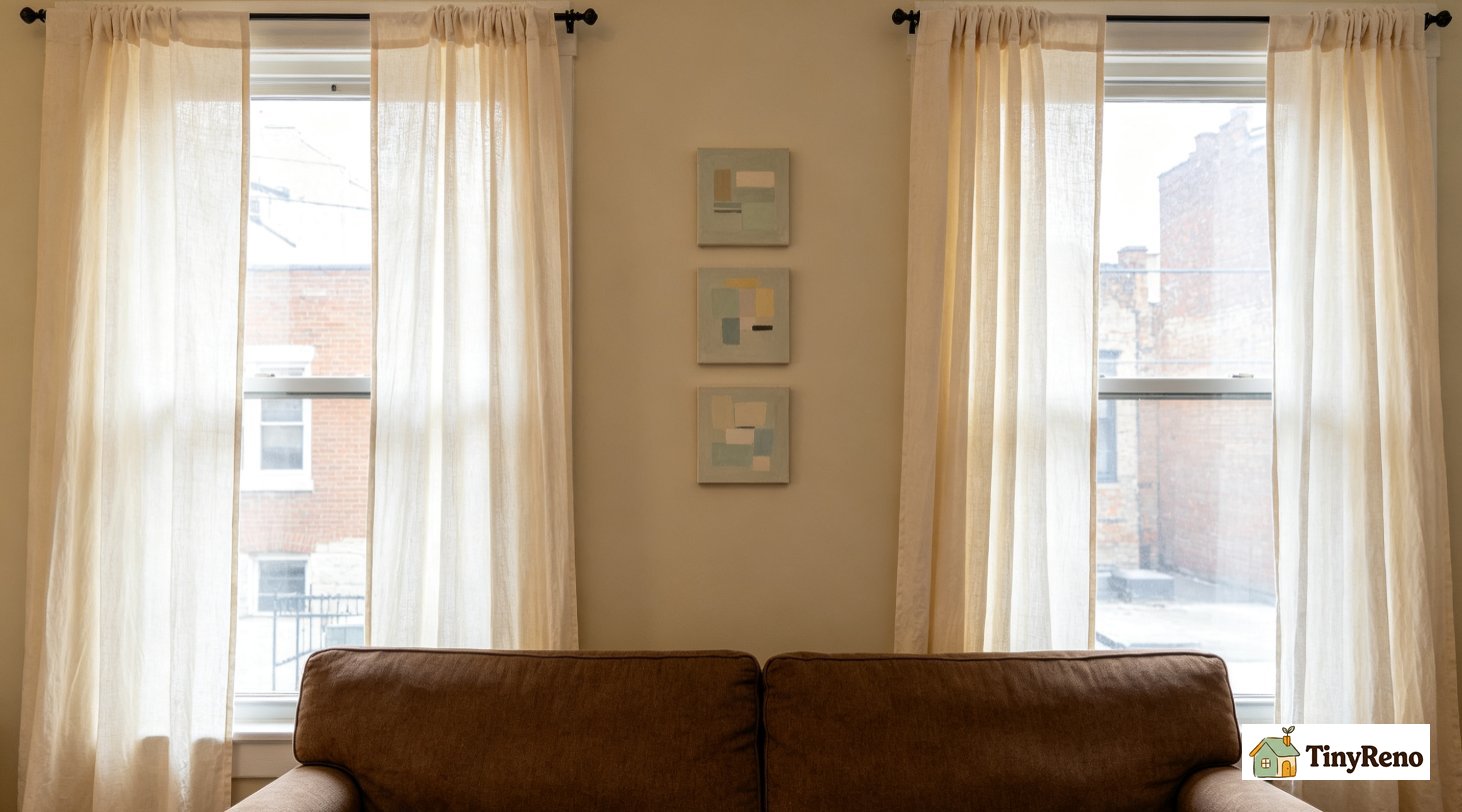
Swap three was the curtains. The west-facing window had a single white vinyl blind that came with the apartment. The blind was functional and ugly and did not frame the window. We measured the window at sixty inches wide and sixty-eight inches tall, and we bought two curtain panels at Target for forty-eight dollars total. The curtains were a warm cream color with a subtle linen texture, and we hung them from a tension rod that did not require drilling into the wall. The rod was twenty-six dollars. The total for swap three was seventy-four dollars. The curtains did two things the blind did not. They framed the window so the window looked intentional instead of leftover, and they softened the light coming through, which made the room feel warmer at four in the afternoon when the west sun hit.
Swap four was the art. My wife has a friend named Hannah who is a printmaker in the Detroit-Shoreway neighborhood, and Hannah had three small matted prints she was trying to get rid of before her studio move. The prints were abstract, in muted greens and rust, and they were the right size for the wall above the couch. We paid forty dollars for the three of them and my wife hung them in a vertical column on Saturday evening. This is the part of how to decorate a small living room on a budget that most people think requires a lot of money. It does not. Art is one of the easiest things to find cheap if you know artists who are moving studios, selling work, or running end-of-year sales. Etsy, local art walks, and university print sales are the other three sources we would have tried.
Why The Order Matters And The Mistake Most Renters Make
The order mattered for two reasons. The first is that each swap made the next swap easier to evaluate. Putting the rug down first meant we could see how the floor lamp interacted with the rug, and whether the lamp was in the right corner. Putting the curtains up before the art meant the wall color was right for the prints. Doing it in any other order would have meant redoing at least one swap, and the redo was what we did not have time for. The second is that the early swaps were the high-impact, hard-to-return items, and the later swaps were the soft, returnable ones. Rug and lamp first, because returning a seventy-nine-dollar floor lamp to IKEA is a Sunday trip we did not want to make. Curtains third, because curtains are also a hassle to return. Art fourth, because prints from a friend are not returnable at all and we wanted to be sure of the room before we hung them.
The mistake most renters make when they try to decorate a small living room on a budget is they buy the small things first. The throw pillows, the candle, the wall sticker, the vase. The small things cost money, the room does not change, and the renter concludes that decorating on a budget does not work and gives up. The small things are the wrong starting point. The high-impact big items are the right starting point. A rug, a lamp, curtains, and one piece of art will change a small living room more than fifty dollars of small things. The total spent on the first four swaps was two hundred and sixty-two dollars. We had one hundred and eighteen dollars left for the last two swaps, which is plenty.
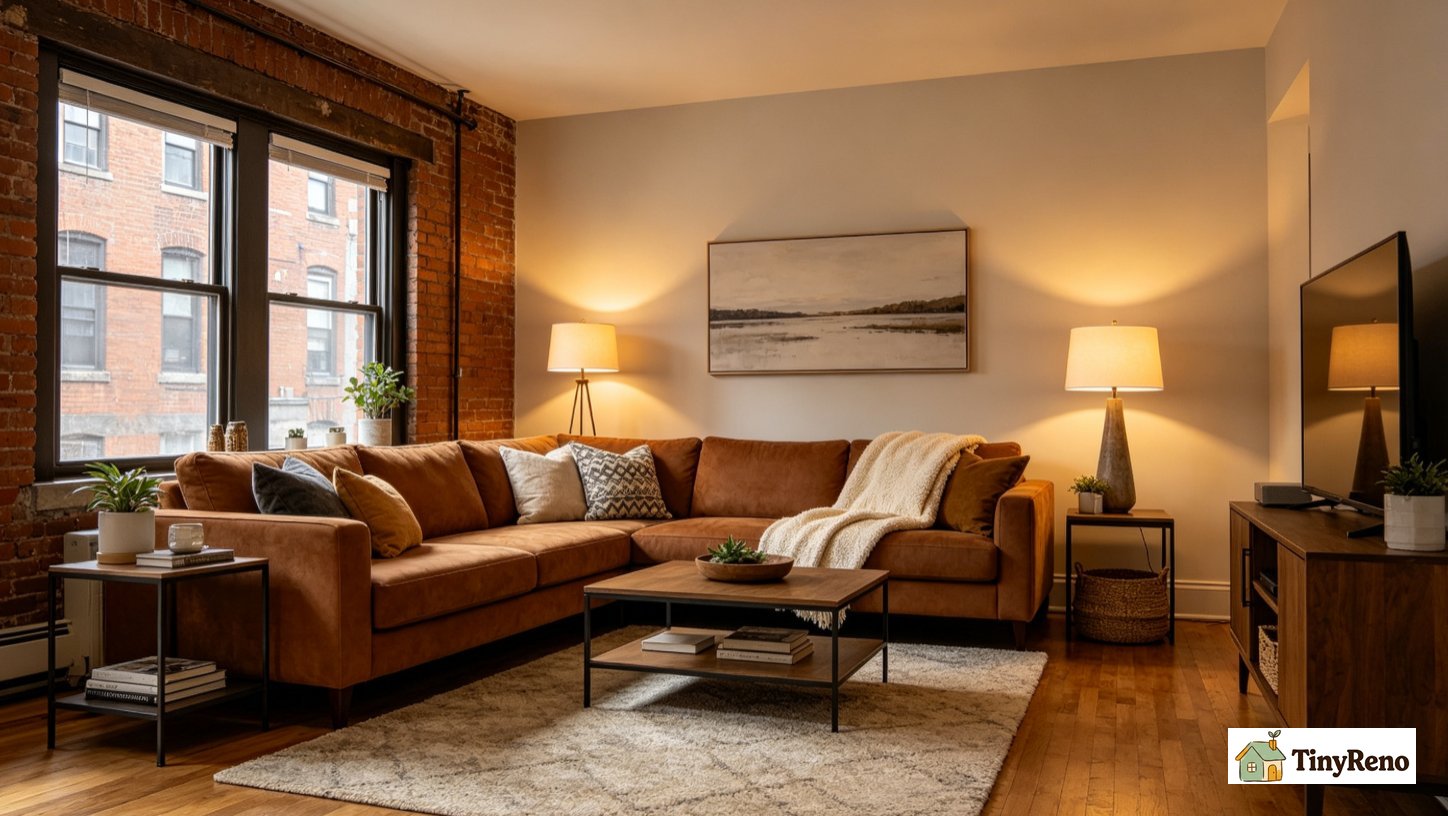
Swap five was the coffee table styling. We did not buy a new coffee table. We bought three things to put on the one we already had: a stack of three hardcover books from the Cleveland Public Library used-book sale at $3 each ($9 total), a small ceramic vase from the West Side Market for $12, and a $12 candle from HomeGoods. The total was $33. The styling made the coffee table look intentional. Before styling, it was a folding card table covered with mail and the half-eaten bag of pretzels. After styling, it was a coffee table. The rule for a small surface is fewer items, taller items, and one thing from nature. The vase with a single faux eucalyptus stem was the thing from nature; the candle was the tall item; the books were the fewer items.
Swap six was the throw blanket and pillow set. The cord-brown couch was the third most visible thing in the room after the rug and the lamp, and the brown was fighting the cream. We bought two cream-and-rust throw pillows and one cream throw blanket at HomeGoods for $85 total. The couch was still brown, but the cream and rust broke it up, and the brown became a background instead of the dominant color. This was the smallest visual change of the six and the highest total cost, for the least visual return. If we had to drop one swap to save money, this is the one we would have dropped. The room would have been fine without the pillows; it was not fine without the lamp.
What We Spent, What We Skipped, And The One Swap I Would Add
The total spent was $380, exactly on budget. The breakdown: rug $69, floor lamp $79, curtains plus rod $74, art $40, styling $33, pillows plus blanket $85. The six swaps took about nine hours across Saturday and Sunday, including the Saturday lunch sandwich run at the bakery on Professor Street, the IKEA trip, the Target trip, the HomeGoods trip, the West Side Market stop, and the time my wife spent arranging and rearranging the prints until she was happy with the spacing.
The swap I would add if we had a fourth day and another hundred dollars is a tall plant in the back-right corner, opposite the floor lamp. A live snake plant or zz plant in a tall woven basket would have given the room another vertical element and softened the right side the way the lamp softened the left. We did not do this swap because we were out of time and budget, and because plants need watering and our landlord's policy on plant water damage was unclear. The next swap on our list, when we have the money and the lease allows, is exactly that. A tall plant, a woven basket, and a saucer the landlord will not yell about.
The result of the weekend is a 380-square-foot living room that does not feel like a dorm. It feels like a room we chose, on a budget we could afford, in a weekend we had. The room is not large; it is the same eleven by fourteen it was on Friday night. What changed is that the things in it now look picked rather than left behind. The rug anchors the floor, the lamp gives the room depth, the curtains frame the window, the art fills the wall, the coffee table is styled, and the couch is dressed. The total is $380, exactly the budget. The order mattered, and the lamp mattered most. My wife was right to sigh.


Discussion (0)
Sign in to join the discussion