

I started looking for lighting options for a small apartment without overhead fixtures in February, from a 480-square-foot one-bedroom in Shadyside, Pittsburgh. The ceiling fixture in the living room had failed its move-in inspection, and my landlord said she would not replace it before the next quarter. The room was twelve by sixteen, with a west-facing window, builder-beige walls, and one floor outlet in the back-left corner. I did not want to rely on a single corner floor lamp; I had tried that before, and the result looked like a hospital waiting room. Over two weeks I bought five fixtures and lived with each one for two to three nights. Three were disappointing, one changed the room, and one was the surprise winner.
I tested five fixtures because most design advice stops at “warm bulbs, layered light, mixed heights.” It rarely shows what a $79 IKEA paper-shade lamp actually does to a beige wall compared with a $140 arc lamp, because the photos are professionally staged and lit. What matters is what the room looks like at nine p.m. after you have lived with the lamp for a few nights.
Why Overhead Lights Are Usually The Wrong Starting Point
Quinn, a lighting designer who runs a studio on Penn Avenue in the Strip District, told me in our first call that overhead lights are often how builders meet code rather than how designers shape a room. A code-compliant ceiling fixture throws even, flat light from above, which is often the least flattering light in a small space because it flattens shadows. A room lit that way can feel like a doctor’s waiting room. Without overhead fixtures, the way to get shadow and contrast is to build the room from portable lamps.
Quinn's rule for a small apartment is two sources of light per room at different heights. A floor lamp and a table lamp is the minimum. A third, like a wall sconce or shelf light, is the full setup. Each light source has to be on a separate switch or a smart plug so you can change the mood without leaving the couch.
Fixture One: The Thirty-Nine-Dollar Table Lamp
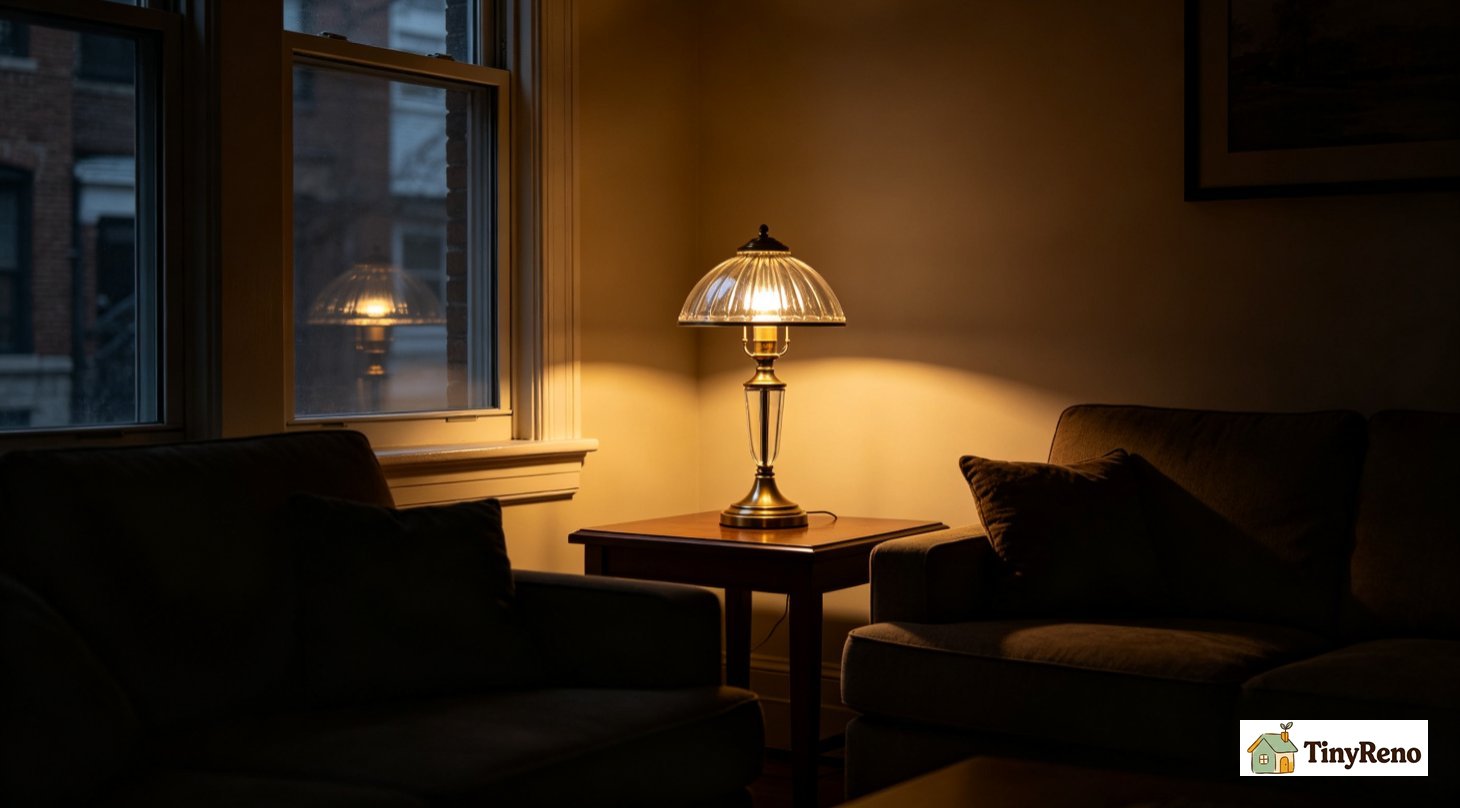
Fixture one was a $39 brass-and-glass table lamp from Target. I put it on the small side table between the couch and the wall, in the only reachable outlet without running a cord across a doorway. The bulb it came with was a 60-watt-equivalent LED at about 2700 K. It produced a single pool of warm light around the table and the right armrest of the couch; the rest of the room stayed flat and dim. The lamp did its job, but its job was lighting a table, not a room.
The drum shade threw light up and down, which helped because the top light bounced off the ceiling and added a soft second source. At $39, it is fairly priced for a task lamp. The problem is that one table lamp in a small room gives you task light, not room light. Task light is what you use to read; it is not what makes a room feel like a room.
Quinn called this the support lamp, not the lead. The support is the light that lets you read; the lead fills the space. In a small apartment without overhead fixtures, the lead is usually a floor lamp, and the table lamp is the support. If you buy the table lamp as the lead, you end up with the same dim living room I had for the first three nights.
Fixture Two: The Seventy-Nine-Dollar Floor Lamp From IKEA
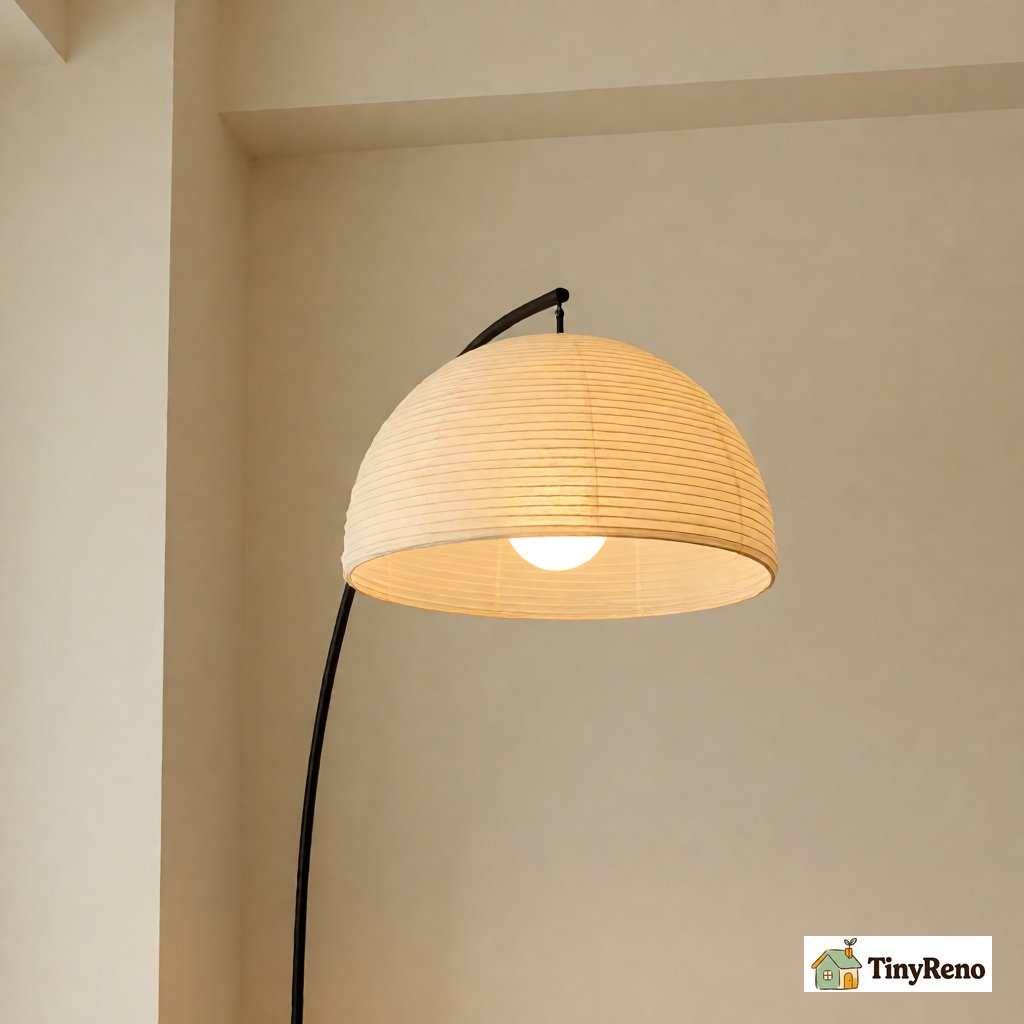
Fixture two was a $79 IKEA floor lamp with a paper shade, the same model my wife and I had used in our Cleveland apartment. I had low expectations because I knew what it did in a 380-square-foot room, and I assumed it would do less in a 480-square-foot room. I was wrong. The paper shade diffused light through the sides and out the top, and the top light bounced off the twelve-foot ceiling and came back down as soft, even ambient light. The room changed. The corners were no longer dark, and the back wall was no longer in shadow.
Quinn called this the turning point in the test. I sent her a photo of the room with the floor lamp on, and she said one floor lamp in the back corner of a small apartment can do much of the work of several overhead fixtures in a larger apartment, because the paper shade throws light up and the ceiling returns it as ambient. The ceiling is the secret weapon: most apartment ceilings are off-white or beige, which makes them good reflectors.
The IKEA lamp was the best ambient lead in the test. It cost $79 and did what a floor lamp should do. It is not pretty; the paper shade yellows after about a year, and the base is a thin pole on a small disc that would not survive a cat. The price and function are right. It is the best ambient-first purchase, but the $49 LED below wins overall because of its built-in dimmer.
Fixture Three: The One-Hundred-And-Forty-Dollar Arc Floor Lamp
Fixture three was a $140 brass arc-style floor lamp I found online. The arc reaches out over a table or couch, and the shade points down so it lights whatever sits under the arc. I bought it for the look and expected it to win because it photographs well. After three nights I returned it. It threw a single pool of light onto the coffee table, which is what the $39 table lamp had already done. The arc was essentially a more expensive table lamp; it did not fill the room, and the rest of the space stayed dim.
Quinn explained why. The arc lamp is a task lamp: it reaches over a chair or desk so light comes from above and behind, like a reading lamp in a library. In a small apartment, an arc lamp often solves a problem you do not have. It cannot give ambient light because the shade points down, and swapping the shade costs more and defeats the purpose.
The arc lamp was the biggest disappointment of the five. It cost the most, did the least, and looked the best in photos. The lesson is that a lamp staged for a design photo is often not the lamp that works in a real apartment. Arc lamps are usually for design studios; paper-shade floor lamps are usually for apartments.
Fixture Four: The Sixty-Nine-Dollar Torchiere
Fixture four was a $69 torchiere floor lamp from Home Depot, the kind with a single uplight bowl that points light straight at the ceiling. Torchieres show up in college apartments and in living rooms where someone has kept the same lamp for fifteen years. I had not seriously considered one because it looked dated, but Quinn told me to test it, and she was right. The torchiere pointed light at the ceiling, and the ceiling bounced it back down. The room filled with ambient light similar to the paper-shade lamp, with one difference: the paper shade threw light up and out, while the torchiere threw light up only. The result was a soft, even glow with no visible source, and the room felt larger.
At $69, the torchiere was $10 less than the paper-shade lamp and did almost the same job. The paper shade also throws light out the sides, which fills corners the torchiere leaves dim. In a smaller room they would be close to a tie; in a 480-square-foot room the paper shade wins by a small margin. If the budget is tight, the torchiere is the cheaper ambient option; the paper shade is the upgrade.
Fixture Five: The Surprise Winner
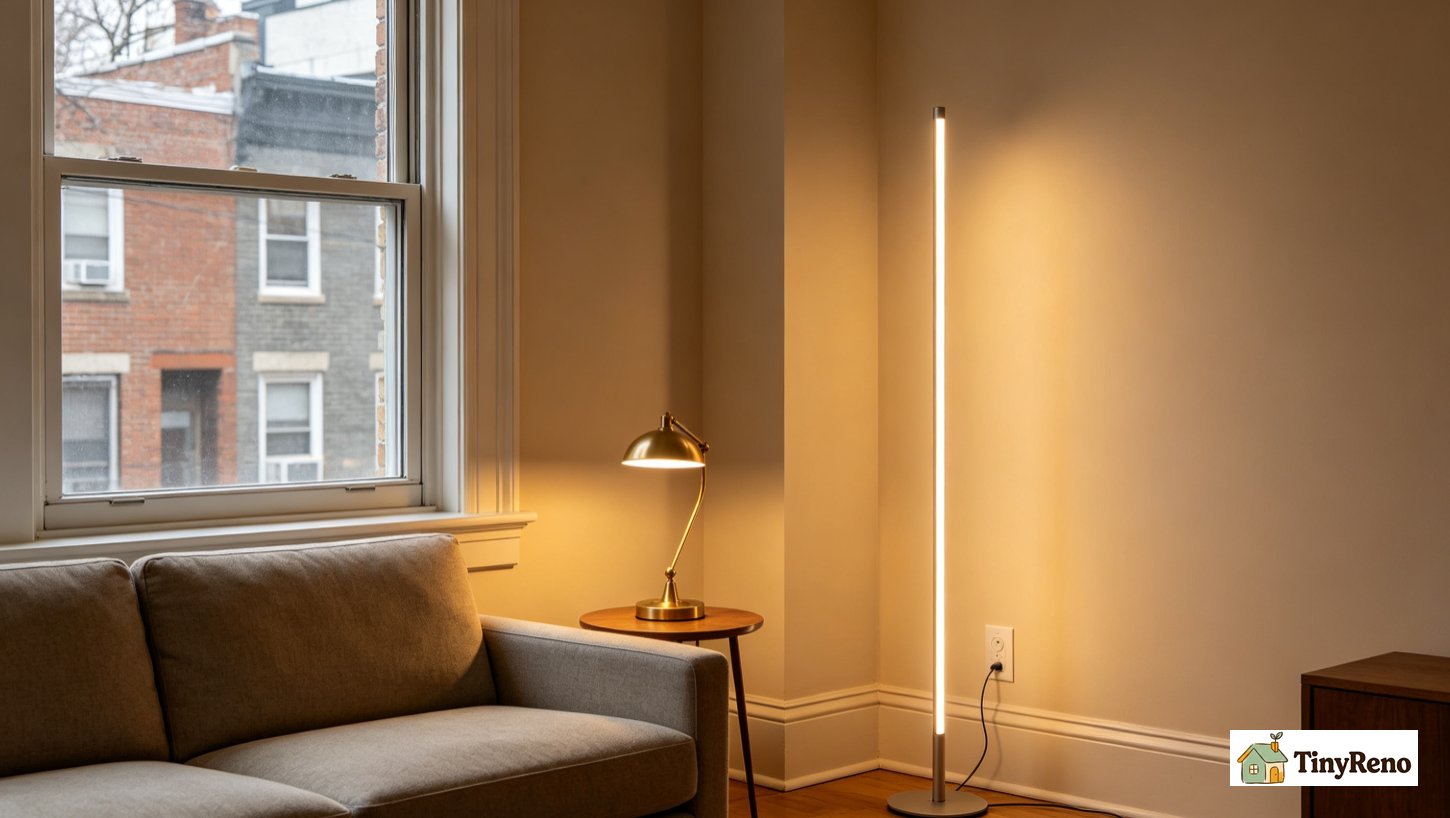
Fixture five was a $49 LED floor lamp from Amazon with a built-in LED strip and a touch dimmer on the pole. I added it on a recommendation from a colleague at the design studio who had used it in her last rental. It arrived in a flat box about the size of a golf bag, assembled in ninety seconds without tools, and produced warm, dimmable light I could adjust from the couch with my foot. The main beam pointed up at the ceiling, so most of the light was indirect ambient bounce; a small downward spill lit the floor under the lamp without lighting the rest of the room.
The surprise winner was the touch dimmer. Dimming is what changes a small lighting setup, because the difference between full brightness and about 60 percent is the difference between a doctor’s office and a living room. Every other lamp I tested needed a separate dimmer, which costs another $15–$30 plus a smart plug or smart bulb. The built-in dimmer on the $49 lamp is one touch on the pole: no app, no setup, just dimming.
It won overall because the paper-shade lamp is the better ambient fixture, but the $49 LED is the better purchase. The paper-shade lamp costs $79 and, to get comparable dimming, needs an external dimmer. The LED costs $49 and has the dimmer built in. The LED plus the $39 table lamp totals $88. The paper-shade lamp plus a separate dimmer plus the table lamp runs over $130. The LED does roughly 80 percent of what the paper shade does for about 60 percent of the price, and the dimmer is the difference between a room you live in and a room you visit.
The Order To Buy In And The One To Skip
Based on two weeks of testing, I would buy the $49 LED floor lamp first and the $39 brass-and-glass table lamp second. Total: $88. That covers the lead and the support. If the budget allows, a third source—a wall sconce or shelf light—adds the layer Quinn says makes a room feel finished. For a 480-square-foot living room, the first two covered the basics.
The fixture to skip is the arc lamp. It is a design object more than a room light: it costs more than the alternatives and does less. It is the lamp you buy for a photo, not for a room. The paper-shade and LED floor lamps are room lamps; the arc lamp is a photo lamp. Skip it and put the money toward the two that work.
The Shadyside living room no longer feels like a hospital waiting room. It has two lamps, a warm glow, and a ceiling doing the work of an overhead fixture. The landlord replaced the ceiling fixture in April, but I kept the LED and the brass table lamp in the living room; the paper-shade lamp moved to the bedroom. Quinn said the room had good shadow contrast, which from a lighting designer is high praise. The surprise winner was the $49 LED. The arc lamp went back to the retailer. The room I am writing this in is lit by the LED and the brass table lamp, about $88 total. The real question is which two lamps you can live with for the next year; for me, it was the LED floor lamp and the brass table lamp.


Discussion (0)
Sign in to join the discussion