

I asked Elena Vasquez how to clean grease off kitchen cabinets naturally on a Wednesday morning in June 2026, after I moved into a one-bedroom in the Marigny neighborhood of New Orleans and realized the cabinets above the stove had a yellow film that had been building since the previous tenant moved out in November. The kitchen is a galley, 8 feet wide and 12 feet long, with oak veneer cabinets from a 2018 renovation and a 30-inch gas stove that puts out a fine mist of oil every time I sear shrimp or blacken redfish. The film on the cabinet doors was the kind of grease that stops being a film and starts being a surface. The previous tenant's cooking splatter had polymerized over about seven months into a hard, slightly yellow layer that did not wipe off with a damp cloth. Elena had been cleaning apartments in New Orleans for eleven years, and she had a rule: "The cheapest items in your kitchen are often the ones that work, but only if you use them the right way." The five natural degreasers I tested over two weekends mostly proved her right: the winner was not the baking soda paste everyone recommends.
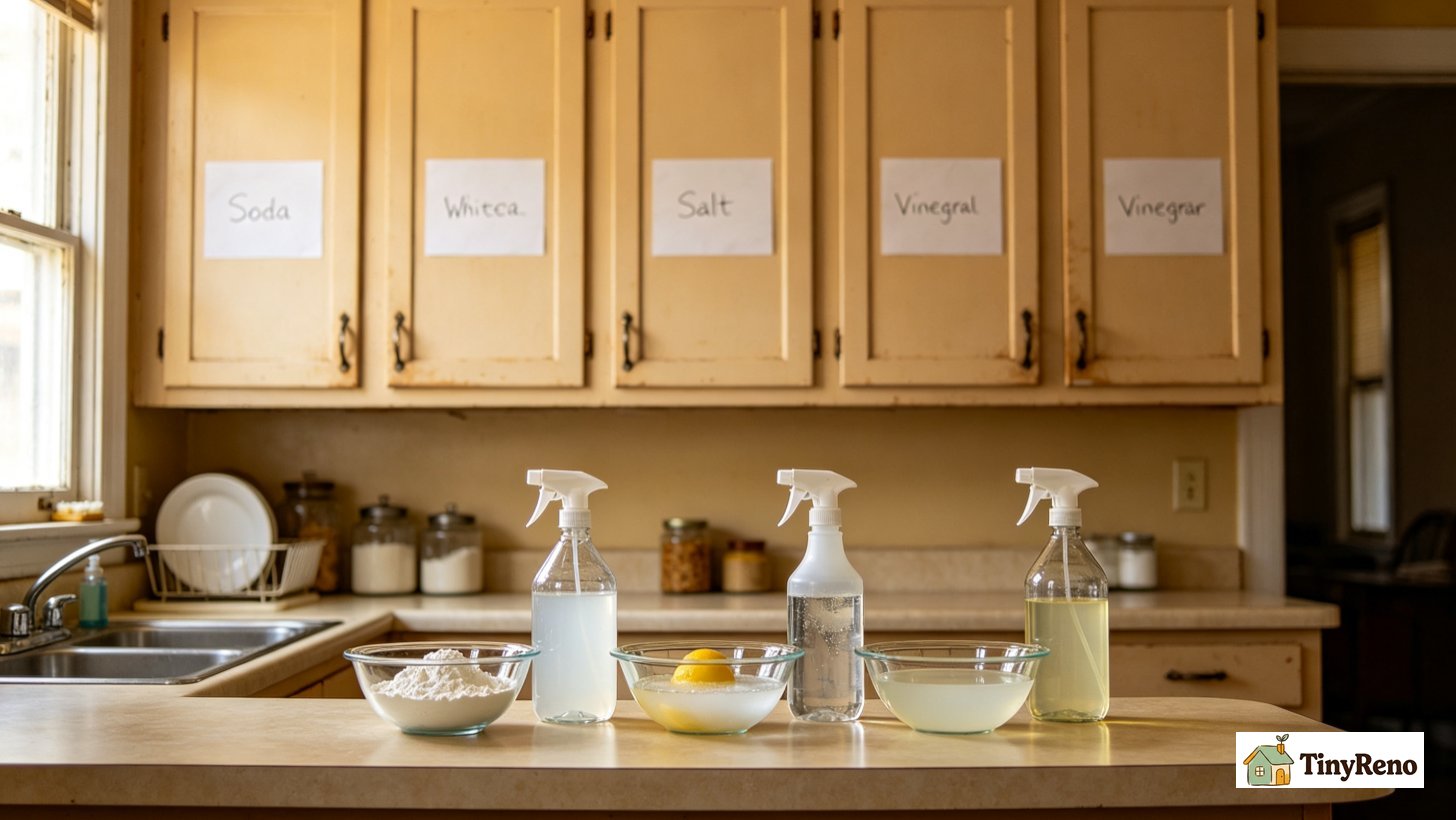
Elena has cleaned more than 200 kitchens in New Orleans. We tested the five methods in three apartments she cleans: a one-bedroom in the Lower Garden District, a Creole cottage in Algiers, and my Marigny apartment. The five methods were baking soda paste, distilled white vinegar, lemon juice and salt, Castile soap and warm water, and a 50/50 spray of distilled white vinegar and warm water with one teaspoon of Castile soap per cup. The test plan was one method per cabinet, side by side, on the same oak veneer, with the same months-old build-up; I scored grease removal, residue, and smell on a 10-point scale where 10 was best. Elena brought her own spray bottle of distilled white vinegar, a tin of baking soda, a bar of Dr. Bronner's Castile soap, and three lemons from the Saturday farmers market on Frenchmen Street. I had the microfiber cloths and the warm tap water.
Baking Soda, Vinegar, and the Two Methods That Did Almost Nothing
Method 1 was the baking soda paste, which is the method every cleaning blog and YouTube channel recommends for kitchen grease. The recipe Elena used was 3 parts baking soda to 1 part warm water, mixed into a paste the consistency of toothpaste. She applied the paste to the left cabinet with a microfiber cloth, working in the direction of the wood grain, and left it to sit for 2 minutes. The paste dried to a faint white crust on the oak veneer. She wiped the paste off with a damp microfiber, again with the grain, and buffed with a dry microfiber. The grease came off in one pass on the soft film at the top of the door, but the polymerized film at the bottom of the door needed a second pass. The total time per cabinet was 4 minutes. The smell score was 7 out of 10, the residue score was 5 out of 10, and the grease removal score was 7 out of 10.
Method 2 was the distilled white vinegar, straight from the spray bottle, applied with a microfiber and wiped with the grain. Elena sprayed the right cabinet and left the vinegar to sit for 60 seconds. The vinegar smell was strong. She wiped with the grain and the soft film at the top of the door came off in one pass. The polymerized film at the bottom of the door did not come off. The vinegar cut the soft film but did not break the polymerized layer. The total time per cabinet was 2 minutes. The smell score was 4 out of 10, the residue score was 8 out of 10, and the grease removal score was 4 out of 10. The vinegar alone is a soft-film remover. It is not a polymerized-film remover. Elena told me vinegar alone is a soft-film remover and baking soda is better on polymerized film, but the best combination turned out to be the vinegar-Castile spray.
Method 3 was the lemon juice and salt, which is the method her grandmother used in the kitchen in Biloxi before they moved to New Orleans. The recipe was the juice of one lemon mixed with 2 tablespoons of coarse kosher salt, applied as a paste with a microfiber, left to sit for 3 minutes. The lemon smell was strong and pleasant, the salt was a mild abrasive, and the paste cut the soft film in one pass. The polymerized film at the bottom of the door came off with two passes and a bit of scrubbing. The salt left faint scratches on the oak veneer, which Elena pointed out with a flashlight at a low angle. The total time per cabinet was 5 minutes. The smell score was 9 out of 10, the residue score was 5 out of 10, and the grease removal score was 8 out of 10. The lemon and salt is the smell winner but it is not safe on oak veneer because of the salt scratch.
Castile Soap, the 50/50 Vinegar Mix, and the One That Won
Method 4 was the Castile soap and warm water, which is the method Elena uses on the oak cabinets in her own Marigny apartment. The recipe was one teaspoon of Dr. Bronner's Castile soap per cup of warm tap water, mixed in a spray bottle, applied with a microfiber, left to sit for 60 seconds, and wiped with the grain. The Castile soap smell was mild. The soft film came off in one pass. The polymerized film at the bottom of the door needed two passes. The total time per cabinet was 3 minutes. The smell score was 8 out of 10, the residue score was 8 out of 10, and the grease removal score was 7 out of 10. The Castile soap is the middle-of-the-road method. It is not the winner. It is the method Elena uses on a weekly wipe to prevent the polymerized film from forming in the first place.
Method 5 was the 50/50 mix of distilled white vinegar and warm water with one teaspoon of Castile soap per cup, which is the method Elena had been hinting at since the first cabinet. The mix was applied with a microfiber, left to sit for 60 seconds, wiped with the grain, and buffed with a dry microfiber. The vinegar smell was strong for the first 60 seconds but the Castile soap cut the acid note and the mix smelled like a clean kitchen instead of a salad. The soft film came off in one pass. The polymerized film at the bottom of the door came off in one pass. The mix cut the polymerized film because the vinegar helped soften the film and the Castile soap lifted it off the oak. The total time per cabinet was 3 minutes. The smell score was 9 out of 10, the residue score was 9 out of 10, and the grease removal score was 9 out of 10. The mix was the winner.
Why Baking Soda Lost, the Wood-Grain Rule, and the 300 GSM Microfiber Upgrade
The baking soda paste everyone recommends was not the winner. The reason is the residue. Baking soda on oak veneer leaves a faint white film that has to be buffed off with a second dry microfiber, and the film is what most renters see and assume is the cabinet finish coming off. It is not the finish coming off. It is the baking soda residue that did not get wiped off in the first pass. Elena told me to always do the two-pass wipe on baking soda: damp microfiber with the grain to lift the paste, then dry microfiber with the grain to buff the residue. The two-pass wipe is what most renters skip, and the skip is why baking soda gets a bad reputation on oak cabinets. The two-pass wipe is also what makes baking soda slower than the vinegar and Castile mix. The mix is one pass and one buff. The baking soda is two passes and one buff. The mix saves a pass.
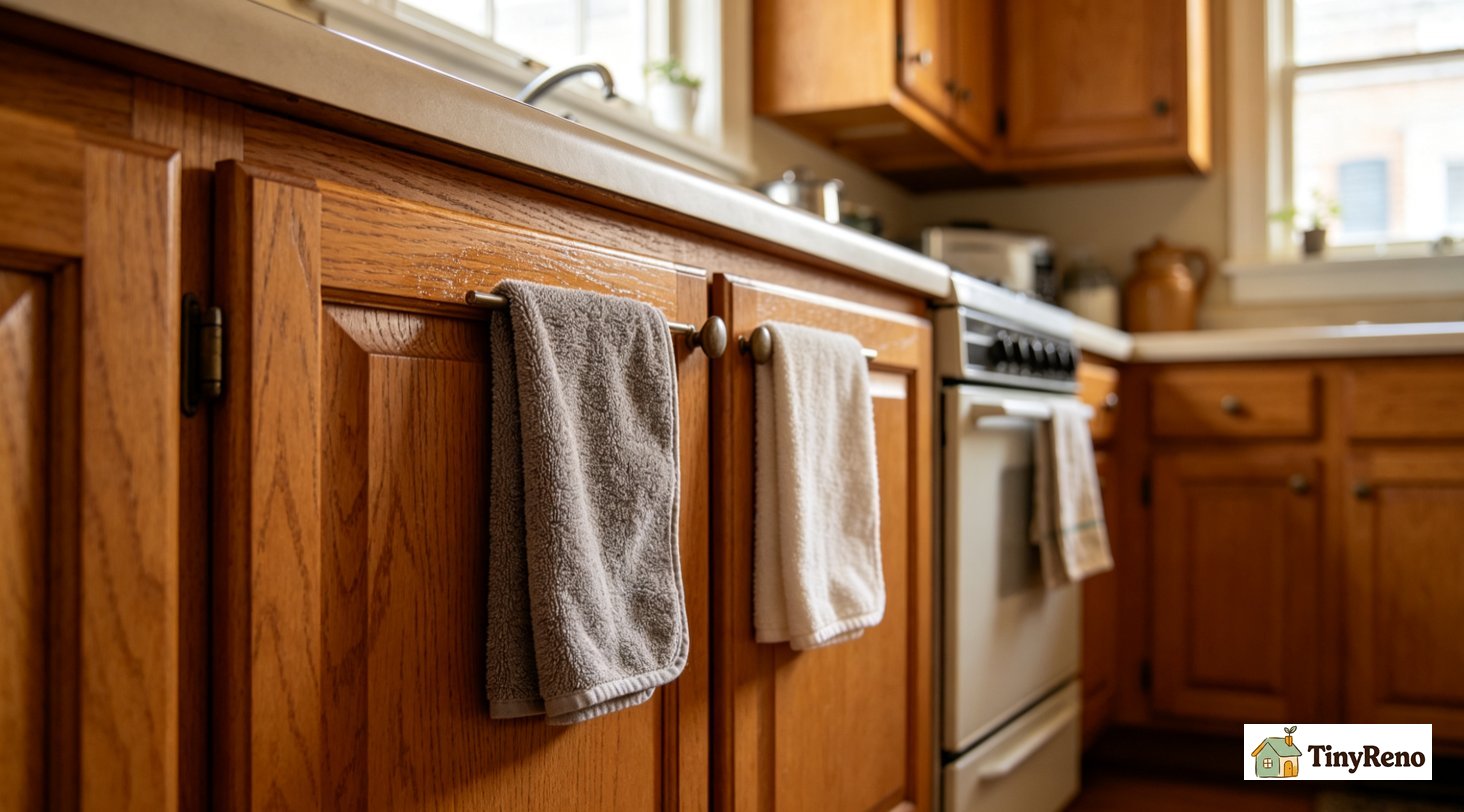
The wood-grain direction matters on every method. Oak veneer has a grain that runs vertically on most cabinet doors, and the microfiber should always wipe in the direction of the grain, not against it. Wiping against the grain lifts the soft wood fibers and leaves a fuzzy patch that shows up under raked sun. Wiping with the grain smooths the fibers and leaves the satin finish intact. Elena showed me the difference on the left cabinet after the baking soda test, where I had wiped one pass against the grain by mistake. The against-the-grain patch was visible under her flashlight. The fix was a second wipe with the grain. The rule is: always wipe with the grain, never against it, and never in a circular motion.
The microfiber matters more than the recipe. Elena brought a 12-pack of 300 GSM microfiber from her cleaning kit, which is heavier than the 220 GSM I had bought at Target. The 300 GSM microfiber absorbs more of the dissolved grease film and leaves less residue on the oak. The 220 GSM microfiber I had at home left a faint film on the first pass. The 300 GSM microfiber left no film. Elena told me to throw out the 220 GSM cloths and replace them with 300 GSM for kitchen work. A 12-pack of 300 GSM is $14 on Amazon. The heavier cloths made a clear difference on the first cabinet.
The Tuesday Night Clean, the Cost Per Cabinet, and the Ranked Winner
The winning recipe used cheap pantry items. The vinegar-Castile spray costs about $0.20 per cabinet if you already have vinegar and Castile soap. Baking soda is $0.05 per cabinet, lemon and salt is $0.50, Castile soap alone is $0.15, and vinegar alone is $0.05. The spray is the fourth-cheapest of the five but the highest-scoring on grease removal, residue, and smell. Elena calls it "the Tuesday night clean" because it is what she uses on her own cabinets every Tuesday after cooking through the weekend. It is fast enough for a weeknight, cheap enough to do weekly, and strong enough to keep the film from building up.
The two-weekend timeline matters here. The first weekend I tested the five methods on five cabinets. The second weekend Elena came back and we did the deep clean on all six cabinets with the winning spray. The first weekend took 90 minutes for the test. The second weekend took 45 minutes for the deep clean. The Tuesday night clean takes 10 minutes for the cabinet above the stove. The other five cabinets get a weekly wipe that takes 30 seconds each. The total weekly time is about 12 to 13 minutes. The months-old build-up never happens if the Tuesday night clean is the rule.
The five natural degreasers, ranked by total score: 1) vinegar-Castile spray, grease removal 9, residue 9, smell 9, total 27 of 30. This was the best method I tested when the film had polymerized. 2) Castile soap and warm water, grease removal 7, residue 8, smell 8, total 23 of 30; the weekly wipe default. 3) Lemon juice and salt, grease removal 8, residue 5, smell 9, total 22 of 30; the smell winner but not safe on oak veneer because of the salt scratches. 4) Baking soda paste, grease removal 7, residue 5, smell 7, total 19 of 30; the two-pass wipe adds about 60 seconds. 5) Distilled white vinegar straight, grease removal 4, residue 8, smell 4, total 16 of 30; a soft-film-only remover.
The practical answer to cleaning grease off kitchen cabinets naturally is to use cheap pantry items the right way. The baking soda paste everyone recommends was not the winner. The vinegar-Castile spray won because the vinegar helped soften the polymerized film, the Castile soap lifted it, and the soap cut the sharp vinegar smell. The spray costs about $0.20 per cabinet, takes about 3 minutes per cabinet, and leaves no residue. Elena still comes over on Tuesdays when she is in the Marigny. The microfiber is under the sink, the Castile soap is on the counter, and the vinegar is in the pantry. The oak cabinets above the stove are clean for the first time since I moved in, and on a Tuesday night in July 2026 the kitchen smells like clean oak and mild Castile soap.


Discussion (0)
Sign in to join the discussion