

Fall decor without damaging the walls was the project I tackled my first October in this Astoria lease. My roommate at the time had already lost part of her damage deposit from nails in the living room, so the rule was hard: nothing goes through the wall. That October I worked out seven swaps that hold up through March and come off clean by May. Five of them are renter staples, and two are the ones people tend to skip and regret. If you want fall decor without wall damage, these are the seven swaps I use every year.
The damage I caused the year before I learned the swap
My sophomore year in a different rental, I hung a full autumn garland across one wall using 16 small nails. The landlord handed me a $185 deduction at move-out for "wall repair and paint touch-up." I bought a sample pot of eggshell paint and patched it myself, but the lesson stuck: a regular nail leaves a hole bigger than spackle can fill cleanly. The rule I settled on after that was simple: nothing goes through drywall unless the lease explicitly says picture hangers are fine, and even then I prefer removable. The swaps are built around that one rule.
The swaps below cover the main fall visual moves: garland, centerpiece, wall art, and textiles. For the wall pieces, each has a nailed option and a removable option. The nailed options are faster the day you hang them, but the removable options still hold on day 90, and the move-out walk-through takes 15 minutes instead of an afternoon of patching.
Comparing the 7 swaps side by side
I tested each swap in two apartments over three Octobers: the Astoria studio with my roommate and a one-bedroom I rented alone in 2023. The middle column shows how long each swap held before I had to redo it, and the right column shows what the landlord saw at move-out. None of these required a drill.
| Swap | What I used | How long it held | Move-out result |
|---|---|---|---|
| Garland across the door frame | Removable hooks + clothespins | 6 months | 0 peel, 0 ghost |
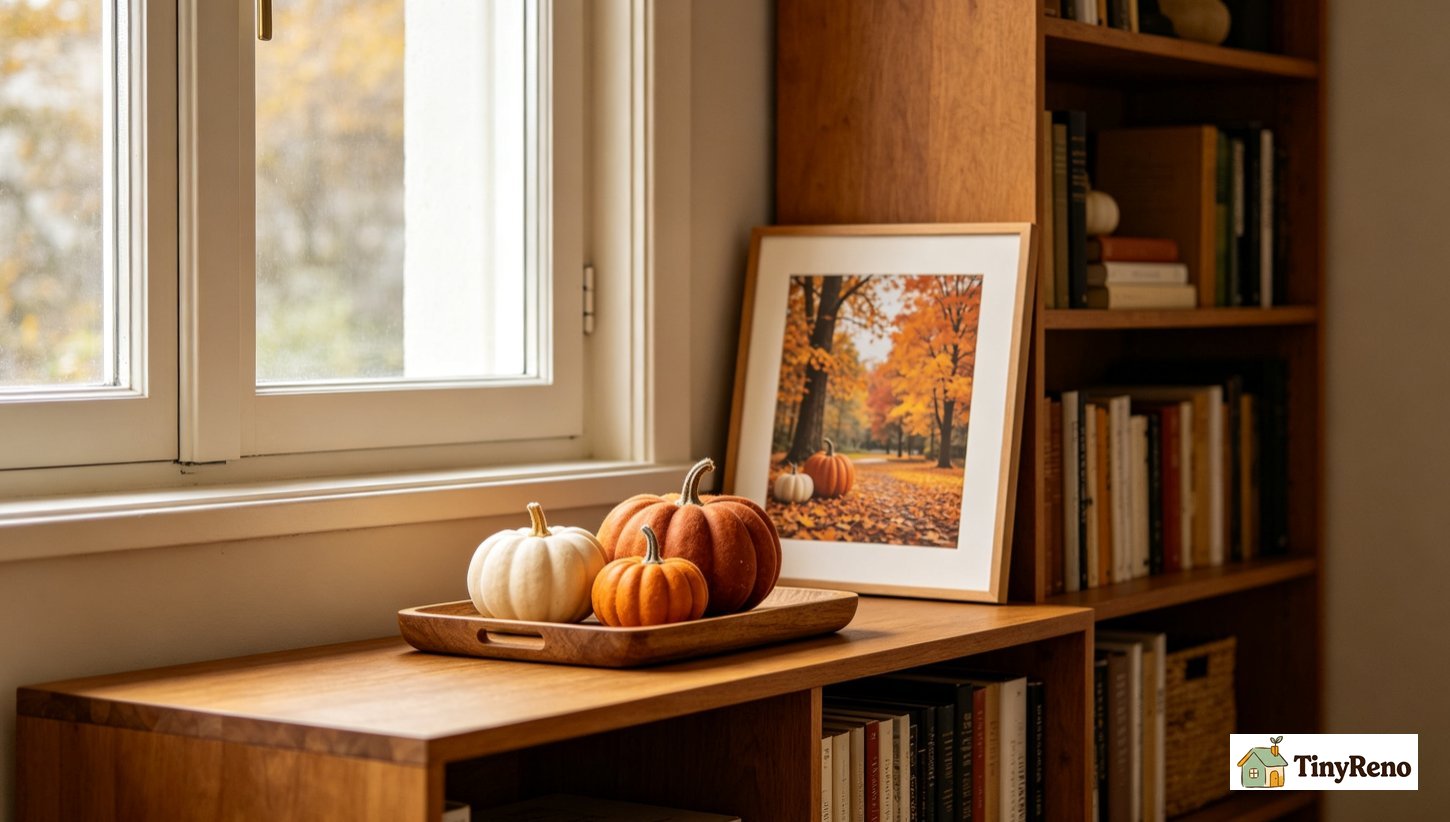
| Large autumn print on the main wall | Leaning frame against bookshelf | Whole season | No holes at all |
| Pumpkin cluster on the entryway console | Three faux pumpkins on a wood tray | Whole season | Nothing on the wall |
| Throw blanket over the sofa | Folded blanket at the back of the couch | Whole season | No wall contact |
| Wreath on the front door | Over-the-door hook | Whole season | No nail mark |
| Table runner on the dining surface | Runner and weighted bowl | Whole season | No holes anywhere |
| Window film with leaf pattern | Static-cling removable film | Whole season | Peels off in 30 seconds |
The longest hold was the door-frame garland, which surprised me: the removable hooks on the inside frame held a 3-foot eucalyptus-and-pinecone garland from October through April and then came off without taking any paint. The shortest hold by feel was the static-cling window film, which started peeling in direct sun by week three. It still came off with no residue, so the real measure is whether you need to reapply it mid-season.
Where most renter fall swaps go wrong
I see three recurring problems when friends ask why their no-damage fall decor falls apart. First, they hang the wreath with a single nail because it is faster than reading the over-the-door hook box. Second, they hang the print with a single nail because they trust the wall. Third, they hang the garland with painter's tape because command strips feel expensive. All three end with the same move-out paint touch-up bill.
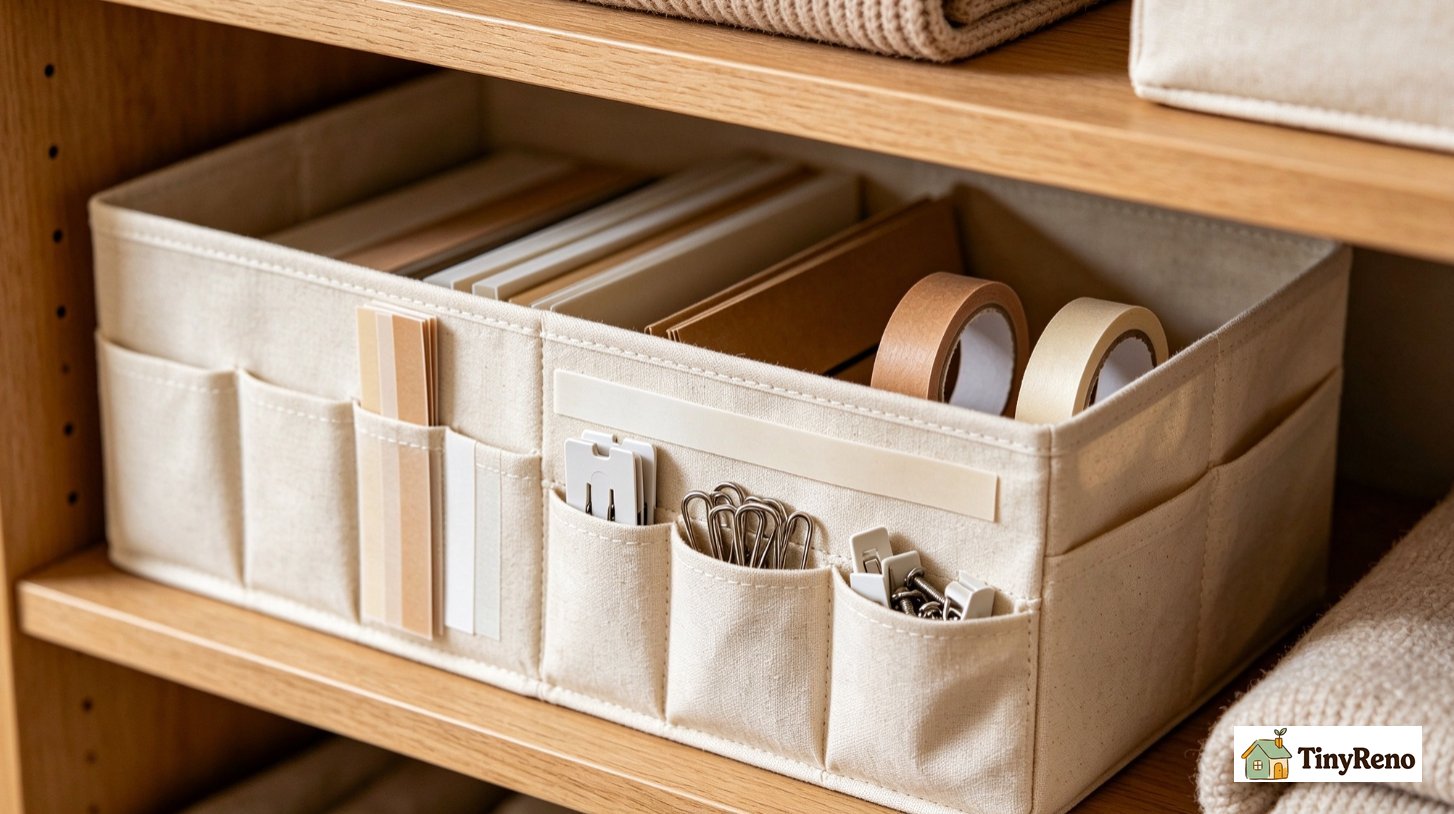
The fix is not spending more money; it is stopping once and using one removable anchor for every wall piece. I keep a small caddy with 12 command strips, 4 removable hooks, 6 adhesive clips, and a few strips of washi tape. The caddy sits in the closet from May to September and comes out the first weekend of October. Replacement supplies cost around $14 each September, far cheaper than even one $45 paint touch-up charge.
The five tools every fall swap needs
- Command medium strips (3M, holds 1.5 lb) for frames, small mirrors, and lightweight prints
- Command large strips (3M, holds 4 lb) for the door-frame garland and heavier frames
- Removable plastic hooks in brass or nickel for wreaths and smaller wall accents
- Washi tape for paper-leaf banners and kid-friendly art projects that come off clean
- Static-cling window film for fall motifs like leaves or pumpkins on the kitchen window
The clip and hook system is what most renter blogs skip over. The removable hooks do more work than most people expect: they hold more weight than command strips alone and come off without leaving the rectangular indentation that strips sometimes leave behind.
Three pitfalls to avoid before you start the swap
First, do not put command strips on freshly painted walls. My apartment had been repainted six weeks before I moved in, and the strips pulled off a small curl of paint in two spots on the first try. Now I only mount on walls that are at least a year old or that I have lived with through one full seasonal humidity change.
Second, do not hang a fall wreath directly on the door with a nail. The over-the-door hook sits flat across the top of the door and holds a heavy wreath without touching the door surface. The hook itself costs about $4 and lasts for three seasons. A nail costs pennies, but the landlord charges per hole.
Third, do not try to hang a real pumpkin by its stem with any removable system. A 4-pound pumpkin is too heavy for most command strips and too irregular for tape. Set the pumpkin on a tray, on a shelf, or in a bowl. The visual difference between a hung pumpkin and a clustered pumpkin is much smaller than people think.
The seasonal rhythm that keeps the swap manageable
I do the same three-weekend rhythm every year and it takes about two hours total across all three weekends. Weekend one in late September is the wall swap, which is the most disruptive. Weekend two in early October is the textile swap, which is just rotating the throw blanket and the table runner. Weekend three in mid-October is the entryway swap, which is the wreath and the door-frame garland. By Halloween everything is in place and there is no scrambling to hang things.
The bonus is what happens in May. May disassembly takes 45 minutes because every piece has a partner system. Pull each tab down at a slow angle, warm any stubborn strip with a hair dryer for ten seconds, and bundle the hardware back into the caddy. The walls look the same as they did on move-in day. The landlord walks the unit at move-out, signs the form, and the deposit comes back full. That is the result that matters.
If you have one weekend to start, do this
Buy one pack of command medium strips, one removable brass hook, and one over-the-door wreath hook. Hang one wreath on the front door. Lean one large autumn print against the bookshelf. Cluster three faux pumpkins on the entryway tray. That is the 30-minute version of the swap, and it covers three of the seven moves. If you like the look, add the garland and the textile swaps the next two weekends. If you do not like it, you have spent about $14 and made zero holes in the wall.
I have done the full swap three Octobers in a row now, and the Astoria walls have stayed untouched for three years running. That is the standard I keep coming back to. A swap that survives Halloween, Thanksgiving, and a February thaw is doing the job it was designed for: protecting the deposit.
What I changed about the swap this year
One small change I made in 2025 that I will keep: I switched the door-frame garland from eucalyptus-and-pinecone to a dried wheat bundle. The wheat bundle weighs almost nothing, has no sap, and comes down in May without any insect problem. The visual is just as warm and the cleanup is much faster. I also added a thin runner down the center of the entryway bench, which is removable in five seconds and adds another layer of fall texture without adding anything to a wall.
The full seven-swap setup costs about $65 in supplies the first year and about $14 each year after, plus whatever you spend on decor pieces like the wreath, the garland, and the pumpkins. My roommate and I split it the first year and split the replacement again in year three. The damage deposit has stayed whole for the third October in a row, which is the only result I really care about at the end of the season.


Discussion (0)
Sign in to join the discussion